

35% vs 20% Window Tint in Illinois is a choice that involves more than deciding which shade looks better. Illinois law treats the windows beside the driver differently from windows behind the driver, so a tint level that may work in one location may not fit the rules in another. For many drivers who want aftermarket tint on both the front and rear side windows, 35% is the easier legal configuration to understand. A 20% tint is darker and gives more privacy, but it does not fit the standard Illinois front-side window tint options.
The difference is also easy to see from inside the vehicle. A 35% tint lets more visible light through, which can help with nighttime visibility. A 20% tint creates a darker appearance and cuts more visible glare, but that darker view can be noticeable after sunset or in poorly lit areas.
The Detail Dynasty provides professional window tint installation from its dedicated garage facility in Skokie, IL & Chicago’s North Shore. If you are deciding between tint levels for your vehicle, call (773) 216-3104 or visit the contact page.
This article explains the current Illinois rules in plain language. It is general information, not legal advice. Window tint laws can change, so check the current Illinois Vehicle Code before having film installed.
Table of Contents
- 35% vs 20% Window Tint in Illinois at a Glance
- What Does 35% Window Tint Mean?
- What Does 20% Window Tint Mean?
- Is 35% Window Tint Legal in Illinois?
- Is 20% Window Tint Legal in Illinois?
- 35% vs 20% Tint on Front Side Windows
- 35% vs 20% Tint on Rear Windows
- 35% vs 20% Tint for Night Driving
- 35% vs 20% Tint for Privacy
- Does 20% Tint Block More Heat Than 35%?
- How Factory Glass Changes the Finished Tint
- The Illinois 35% Tint Configuration
- What If You Want 20% Tint in the Rear?
- What About the Windshield?
- Which Tint Should You Choose?
- Schedule Window Tint Service
- Frequently Asked Questions
- Sources
35% vs 20% Window Tint in Illinois at a Glance
The biggest difference between 35% and 20% tint is the amount of visible light that passes through the glass.
A lower percentage means a darker finished window.
Here is a simple comparison:
| Tint Level | Visible Light | Appearance | Front Side Use Under Standard Illinois Rules |
|---|---|---|---|
| 35% | More light passes through | Medium-dark | Permitted as part of the 35%/35% configuration |
| 20% | Less light passes through | Darker | Does not fit the standard front-side configurations |
Illinois law does not treat every window on the vehicle the same way.
The windows immediately beside the driver have specific light-transmission requirements. The tint level used behind the driver’s seat can affect which tint is permitted on those front side windows.
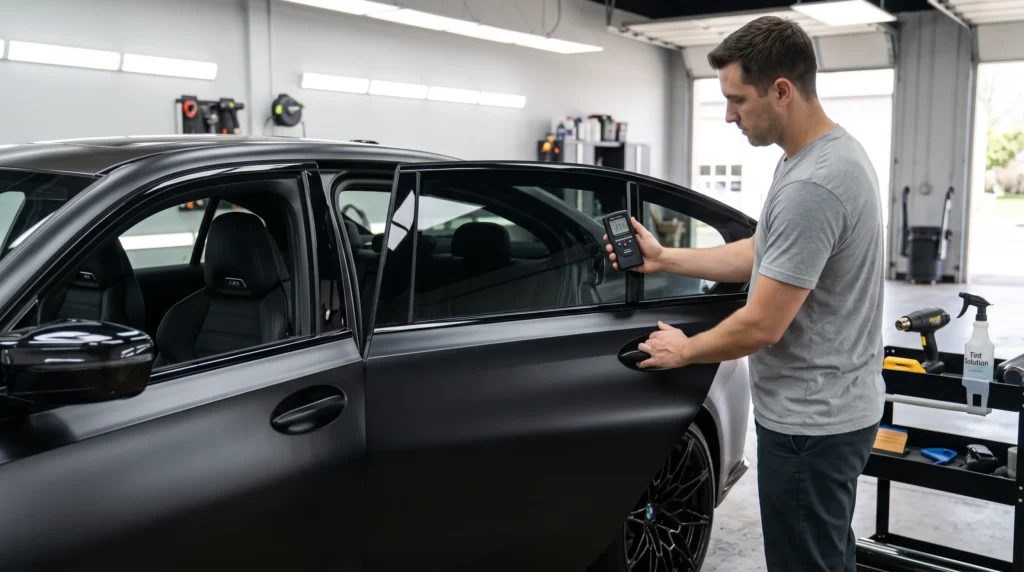
This is why comparing 35% vs 20% Window Tint in Illinois requires looking at the whole vehicle.
What Does 35% Window Tint Mean?
A 35% VLT window allows roughly 35% of visible light to pass through the tested glass-and-film combination.
VLT stands for Visible Light Transmission.
Higher VLT numbers mean lighter windows. Lower VLT numbers mean darker windows.
A 35% tint usually gives a noticeable tinted appearance without making the cabin as dark as a 20% film.
Drivers often consider 35% because it can provide:
- More privacy than clear glass
- Less visible glare
- A darker exterior appearance
- More interior light than 20% tint
- Better nighttime visibility than a darker film in many driving conditions
Illinois law also gives 35% special importance because one of the statutory configurations allows at least 35% light transmission on the front side windows when the rear windows also stay at or above 35%.
What Does 20% Window Tint Mean?
A 20% VLT allows about 20% of visible light to pass through the tested window.
That makes it noticeably darker than 35%.
Drivers may like 20% tint because it can give:
- More visual privacy
- A darker exterior appearance
- Greater reduction in visible glare
- Less visible light entering the cabin
The tradeoff is visibility.
A darker window can make it harder to see outside at night, especially on poorly lit residential streets, in parking areas, during rain, or when backing into a dark space.
The legal issue matters too.
A 20% tint level is below the standard Illinois front-side thresholds listed in Section 12-503.
Is 35% Window Tint Legal in Illinois?
Yes, 35% tint can be legal on the front side windows when the rest of the vehicle fits the 35% configuration in Illinois law.
Under 625 ILCS 5/12-503, the windows immediately beside the driver may have nonreflective film that allows at least 35% light transmission when none of the windows behind the driver’s seat are treated below 35% light transmission.
That creates a straightforward arrangement:
- Front driver window: at least 35%
- Front passenger window: at least 35%
- Rear side windows: at least 35%
- Rear window: at least 35%
The statute also states that law enforcement observes a 5% variance when metering the front-side light transmission.
That variance should not be treated as a target for choosing darker film. The written configuration still calls for at least 35% light transmission.
For someone comparing 35% vs 20% Window Tint in Illinois and wanting tint across the side and rear windows, the 35% setup is much easier to match to the written rule.
Is 20% Window Tint Legal in Illinois?
The answer depends on where the 20% tint is installed and what is happening with the front side windows.
20% on the Front Side Windows
A 20% tint level does not fit the standard front-side options stated in Illinois law.
Section 12-503 provides these common front-side choices:
- At least 50% front-side transmission when rear treatment stays at or above 30%
- At least 35% front-side transmission when rear treatment stays at or above 35%
- At least 50% front-side transmission when the rear smoked or tinted glass was originally installed by the vehicle manufacturer
Twenty percent falls below those standard front-side levels.
20% Behind the Driver
Rear-window treatment is more complicated.
The 30% and 35% rear thresholds in Section 12-503 are conditions that determine whether aftermarket tint may also be placed on the windows immediately beside the driver.
If the windows immediately beside the driver are left without aftermarket tint, the section does not state the same fixed 30% or 35% minimum for the rear windows.
The statute does state that vehicles with treated windows behind the driver’s seat must have a side mirror on each side that meets Illinois mirror requirements.
What this means is that someone considering 20% rear tint should not assume that 20% can simply be paired with 35% front-side tint.
That combination does not match the 35/35 setup written into the statute.
35% vs 20% Tint on Front Side Windows
For front driver and passenger windows, 35% is the stronger choice if your goal is to stay within one of the standard Illinois tint configurations.
Illinois expressly provides for at least 35% front-side light transmission when the rear treatment also stays at or above 35%.
A 20% front-side tint does not fit that rule.
There is also a visibility difference worth thinking about.
When you turn across traffic at night, check for a cyclist, look for a pedestrian, or pull out of a dark driveway, you are looking through those front side windows.
A 35% tint lets more visible light reach your eyes than a 20% tint.
For a vehicle that sees regular nighttime driving, that difference may matter more than the darker look of 20%.
35% vs 20% Tint on Rear Windows
Rear glass gives drivers more room to think about privacy and appearance, but the front-side tint setup still matters.
If you want 35% on the front driver and passenger windows, the statute says the treated windows behind the driver’s seat cannot fall below 35% under that configuration.
That means:
35% front + 35% rear fits the written configuration.
By comparison:
35% front + 20% rear does not fit that 35/35 provision.
If you want darker rear film, discuss whether the front side windows will remain untreated and review the current law before installation.
This distinction is one of the most useful things to know when comparing 35% vs 20% Window Tint in Illinois.
35% vs 20% Tint for Night Driving
Twenty-percent tint is darker, so less visible light reaches your eyes through the window.
During daylight, some drivers may prefer that darker appearance.
At night, the difference can become more noticeable.
Think about the conditions where side-window visibility matters:
- Turning at dark intersections
- Looking for pedestrians
- Checking side mirrors
- Backing into a parking space
- Driving through poorly lit neighborhoods
- Entering parking garages
- Driving during rain or snow
- Checking cross traffic
A 35% tint gives you more visible light than 20%.
That does not mean every person will have the same experience. Vision, vehicle lighting, local street lighting, weather, and the existing glass all play a role.
Still, if nighttime visibility is near the top of your list, 35% deserves serious consideration.
35% vs 20% Tint for Privacy
If privacy is the main goal, 20% gives a darker appearance.
It can make it harder to see into the cabin from outside, especially during the day.
Thirty-five percent is still clearly tinted, but it allows more visible light through.
There is another factor: lighting direction.
Even dark tint does not make a vehicle completely private under every condition. If the inside of the car is brighter than the area outside, occupants may still be visible.
For drivers who want a balanced appearance without making the glass extremely dark, 35% can be a good middle ground.
For drivers who want darker rear glass and plan to leave the front side windows untreated, a darker rear choice may be worth discussing with the installer after checking the vehicle configuration against Illinois law.
Does 20% Tint Block More Heat Than 35%?
Not automatically.
Darkness and heat performance are different measurements.
A darker window blocks more visible light, but modern automotive film can reject solar and infrared energy without being the darkest film available.
3M makes this distinction in its automotive film data.
3M’s Ceramic IR Series is offered in several VLT levels, and its published technical data shows that films with different visible-light levels can have fairly similar infrared energy rejection figures.
3M also states that its Crystalline Series can reject substantial solar heat while allowing more visible light than many dark films.
This means choosing 20% solely because you think it must reject far more heat than 35% may not give you the result you expect.
Ask about:
- Visible Light Transmission
- Total Solar Energy Rejected
- Infrared rejection
- UV rejection
- Glare reduction
The numbers tell you different things.
If heat control matters more than darkness, compare the actual film specifications.
How Factory Glass Changes the Finished Tint
The number printed on a tint film does not always equal the finished light-transmission reading of the window.
Vehicle glass already reduces some visible light before aftermarket film is installed.
When film is added, the glass and film work together.
This matters when choosing a shade near a legal limit.
A film marketed with one nominal percentage may produce a different measured result once installed on automotive glass.
Factory privacy glass creates another issue.
Many SUVs, crossovers, trucks, and vans already have darker rear glass from the manufacturer.
Illinois law has a separate provision for vehicles where nonreflective smoked or tinted glass was originally installed by the manufacturer behind the driver’s seat. Under that provision, at least 50% light transmission may be used on the windows immediately beside the driver, subject to the metering variance in the statute.
Before selecting film, have the existing glass checked.
The Illinois 35% Tint Configuration
For drivers who want one fairly consistent tint appearance across the side and rear windows, the 35% configuration is easy to understand.
It looks like this:
| Window | Illinois 35% Configuration |
|---|---|
| Front windshield | No full-film tint under the ordinary rule |
| Front side windows | At least 35% |
| Rear side windows | At least 35% |
| Rear window | At least 35% |
The windshield follows a separate rule.
Illinois generally prohibits tinted film across the full front windshield. The statute permits nonreflective film along the uppermost portion as long as it does not extend more than six inches down from the top.
For drivers comparing 35% vs 20% Window Tint in Illinois, the 35% arrangement has a major advantage: the statute directly describes it.
What If You Want 20% Tint in the Rear?
Some drivers like a darker rear cabin but do not necessarily need tint on the windows beside the driver.
That creates a different conversation.
If the front driver and passenger side windows are treated, Illinois ties those windows to rear-window transmission levels.
For the 35% front-side option, the rear windows cannot be treated below 35%.
For the 50% front-side option, the rear windows cannot be treated below 30%.
A 20% rear treatment is below both of those rear thresholds.
If your goal is 20% behind the driver, discuss leaving the front side windows untreated and confirm how Section 12-503 applies to your vehicle before proceeding.
Rear-window treatment also brings mirror requirements. Illinois says a vehicle with treated windows behind the driver’s seat must have a side mirror on each side that complies with Section 12-502.
Most modern cars already have two exterior side mirrors, but the requirement still matters.
What About the Windshield?
Neither the 35% nor 20% comparison changes the ordinary Illinois windshield rule.
Illinois generally does not permit tinted film across the full front windshield.
A nonreflective strip may be placed along the upper portion of the windshield if it extends no more than six inches downward from the top.
There are separate provisions for qualifying medical cases.
Do not assume a lighter percentage makes full-windshield film legal under the standard rule.
If windshield tint is part of your plan, read the current Illinois statute before having it installed.
Which Tint Should You Choose?
For most Illinois drivers deciding between 35% and 20% while planning to tint the front side windows too, 35% is the clearer choice.
It fits the written 35/35 statutory configuration when every treated rear window also stays at or above 35%.
It also allows more visible light through than 20%, which can help when driving at night.
Choose 35% if you want:
- A legal all-around configuration under the standard 35/35 provision
- More nighttime visibility
- A medium-dark appearance
- Tint on both front side and rear windows
- A similar appearance from front to rear
Twenty percent may appeal more if you want:
- Darker rear glass
- More daytime privacy
- Greater visible-glare reduction
- A darker exterior appearance
The catch is where you put it.
Twenty-percent film should not be treated as a standard front-side option in Illinois. It also should not be paired with 35% or 50% aftermarket front-side tint without checking the statutory rear thresholds.
For many drivers, the question is not really “Which tint looks better?”
It is “Which tint gives me the appearance and visibility I want while fitting the legal configuration of my vehicle?”
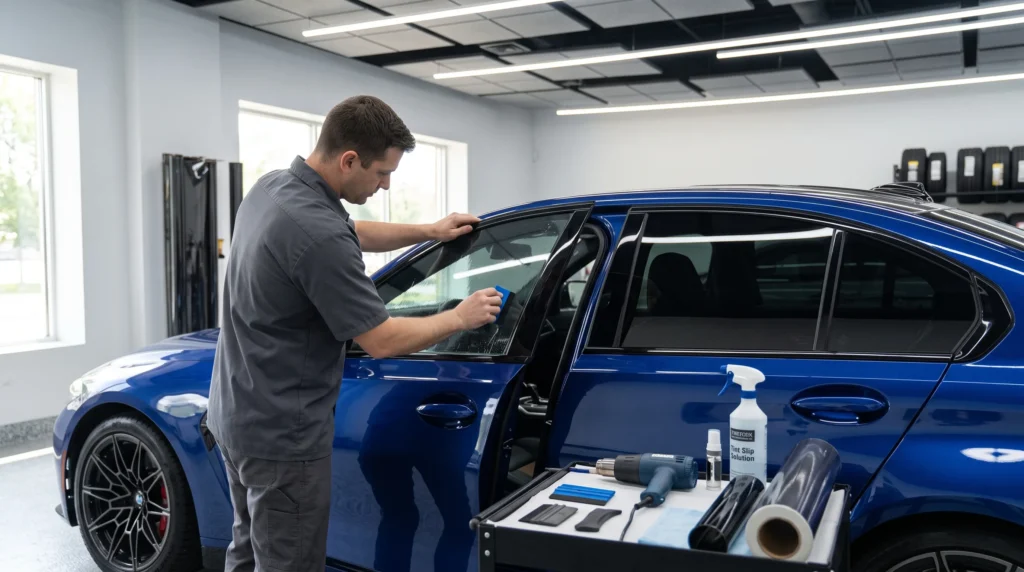
That is the better way to approach 35% vs 20% Window Tint in Illinois.
Schedule Window Tint Service
If you are comparing 35% vs 20% Window Tint in Illinois, start with your vehicle and the windows you want treated.
A sedan with clear glass may call for a different plan than an SUV that already has dark factory privacy glass behind the driver.
Tell your installer whether you care most about:
- Appearance
- Privacy
- Glare reduction
- UV rejection
- Solar heat rejection
- Night visibility
- Matching factory rear glass
The Detail Dynasty installs automotive window tint from its dedicated garage at 5050 Dempster St, Skokie, IL 60077, serving Skokie, IL & Chicago’s North Shore and surrounding Chicagoland communities.
Tesla owners can also review the Tesla window tint service.
Call (773) 216-3104 or visit the contact page to discuss your vehicle, available film choices, and appointment scheduling.
Frequently Asked Questions
1. Is 35% window tint legal in Illinois?
Yes, 35% can be legal on the windows immediately beside the driver when none of the treated windows behind the driver’s seat allows less than 35% light transmission. This creates the commonly discussed 35% front and 35% rear configuration. Check the current Illinois Vehicle Code before installation.
2. Is 20% window tint legal on front windows in Illinois?
Twenty-percent tint does not fit the standard front-side window configurations stated in 625 ILCS 5/12-503. The statute provides for at least 35% or at least 50% light transmission on the windows immediately beside the driver, depending on the rear-window setup.
3. Can I have 35% front tint and 20% rear tint in Illinois?
That combination does not fit the statutory 35/35 configuration. The 35% front-side provision requires the treated windows behind the driver’s seat to allow at least 35% light transmission. If darker rear tint is your goal, review the complete vehicle setup against the current statute.
4. Is 20% tint darker than 35%?
Yes. Twenty-percent VLT allows less visible light through than 35% VLT. That means 20% generally looks darker, gives more visual privacy, and reduces more visible glare. It can also make nighttime visibility through the glass more difficult.
5. Does 20% tint keep a car cooler than 35% tint?
Not necessarily. Tint darkness measures visible light transmission. Solar heat and infrared performance use different measurements. A higher-quality lighter film can offer strong heat rejection without being as dark as a 20% film. Compare the manufacturer’s solar and infrared specifications rather than using darkness alone.
6. Can I use 20% tint on the rear if my front windows are not tinted?
Section 12-503 ties its 30% and 35% rear thresholds to the provisions allowing tint on the windows immediately beside the driver. If those front side windows remain untreated, the statute does not state the same general VLT floor for rear treatment. Treated rear windows are subject to the statute’s side-mirror requirements. Check the current law and your exact vehicle setup before installation.
7. Where can I get window tint installed in the Skokie area?
The Detail Dynasty provides window tint installation from its dedicated garage at 5050 Dempster St, Skokie, IL 60077, serving Skokie, IL & Chicago’s North Shore and drivers throughout Chicagoland. Call (773) 216-3104 or use the contact form to discuss film options and scheduling.
Sources
- 625 ILCS 5/12-503: Windshields Must Be Unobstructed and Equipped With Wipers
Publisher: Illinois General Assembly
Publication Date: Current statutory text accessed August 2026
Used for: Windshield tint limits, front-side tint configurations, rear-window thresholds, factory tinted glass provisions, metering variance, mirror requirements, and medical exemptions. - People v. Dunmire, 2019 IL App (4th) 190316
Publisher: Illinois Appellate Court, Fourth District
Publication Date: 2019
Used for: Judicial discussion of the Illinois light-transmission percentages, tint-meter readings, and the 5% enforcement variance. - 3M Automotive Window Film Ceramic IR Series Technical Data Sheet
Publisher: 3M
Publication Date: July 2021, Revision B
Used for: Visible Light Transmission, UV block, glare reduction, total solar energy rejection, and infrared performance data. - 3M Automotive Window Films
Publisher: 3M
Publication Date: No publication date listed
Used for: Current manufacturer information about solar heat rejection, UV blocking, film construction, and available automotive film families. - The Detail Dynasty Window Tint Service
Publisher: The Detail Dynasty
Publication Date: No publication date listed
Used for: Internal window tint service link. - The Detail Dynasty Tesla Window Tint Service
Publisher: The Detail Dynasty
Publication Date: No publication date listed
Used for: Internal Tesla window tint service link. - The Detail Dynasty Contact Page
Publisher: The Detail Dynasty
Publication Date: No publication date listed
Used for: Appointment and contact link.
