

Illinois Window Tint Percentages Explained: 15%, 27% & 35% starts with one rule that clears up much of the confusion: lower tint percentages mean less visible light passes through the glass. A 15% window is much darker than a 35% window, while 27% sits between the two. The harder question is whether each percentage fits Illinois law on the front side windows, rear side windows, or rear glass.
Under the current Illinois Vehicle Code, 35% is part of a listed legal configuration for the windows immediately beside the driver. Twenty-seven percent and 15% are not listed as standard front-side tint levels. Rear-window rules depend partly on whether the front side windows are tinted, which is why choosing a percentage based only on appearance can cause problems.
The Detail Dynasty provides professional window tint installation from its dedicated garage in Skokie, IL & Chicago’s North Shore. If you want help comparing tint levels for your car, call (773) 216-3104 or visit the contact page.
This guide explains the statute in plain language and is meant for general information. Illinois law can change, so check the current Illinois Vehicle Code before installation.
Table of Contents
- What Do Window Tint Percentages Mean?
- Illinois Window Tint Rules at a Glance
- Is 35% Tint Legal in Illinois?
- Is 27% Tint Legal in Illinois?
- Is 15% Tint Legal in Illinois?
- 15% vs 27% vs 35% Tint
- How 35% Tint Looks and Feels
- How 27% Tint Looks and Feels
- How 15% Tint Looks and Feels
- Front Side Window Rules in Illinois
- Rear Side and Rear Window Rules
- What the 5% Metering Variance Means
- Why Film Percentage and Finished VLT Can Differ
- Does Darker Tint Block More Heat?
- Which Illinois Tint Percentage Should You Choose?
- Schedule Window Tint Service
- Frequently Asked Questions
- Sources
What Do Window Tint Percentages Mean?
Window tint percentages usually refer to Visible Light Transmission, commonly shortened to VLT.
VLT describes how much visible light passes through glass and film.
A higher number means a lighter window.
A lower number means a darker window.
For the three percentages in this guide:
- 35% tint allows much more visible light through than 15%
- 27% tint sits between 35% and 15%
- 15% tint allows the least visible light through and looks much darker
This is the opposite of how some first-time tint buyers expect the numbers to work.
A 15% film is not lighter than 35%. It is darker because less visible light passes through.
The legal question is based on light transmission, not just the shade name used by a film company.
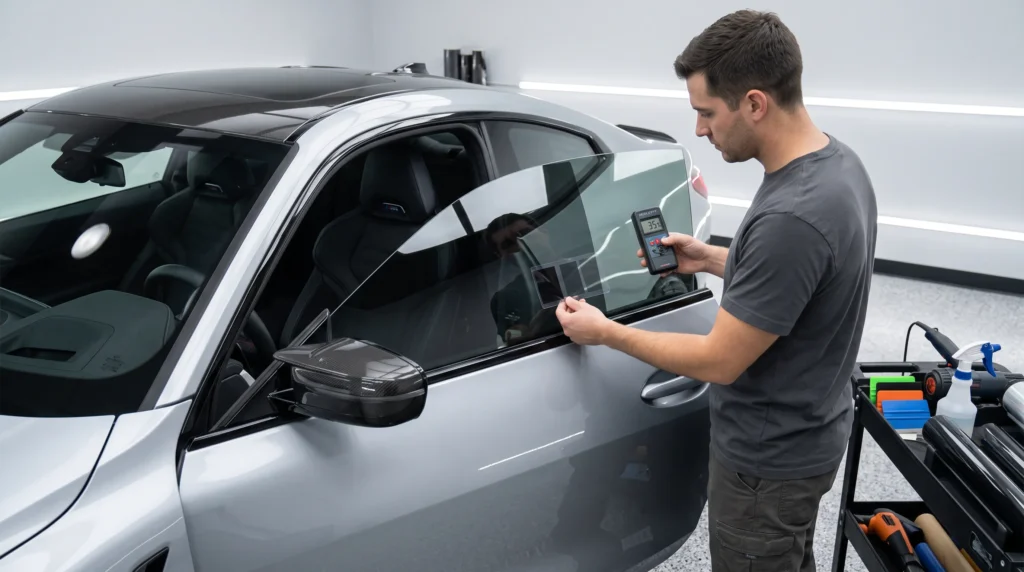
That distinction matters because vehicle glass itself may already reduce visible light before aftermarket film is installed.
Illinois Window Tint Rules at a Glance
Illinois does not use one tint percentage for every window.
The current law provides two common configurations when aftermarket tint is installed on the windows immediately beside the driver.
Illinois 35/35 Configuration
The statute permits nonreflective tint that allows at least:
- 35% light transmission on the front side windows
- 35% light transmission on treated windows behind the driver
Illinois 50/30 Configuration
The statute also permits:
- 50% light transmission on the front side windows
- Rear treatment that does not fall below 30% light transmission
Illinois State Police summarizes the main configurations as:
- Front sides 50%, back 30%
- Front sides 35%, back 35%
- Front sides 50%, back manufacturer tint
That makes 35% a percentage that appears directly in Illinois law.
Neither 27% nor 15% appears as a standard front-side option.
Is 35% Tint Legal in Illinois?
Yes, 35% tint can fit the standard Illinois rules when the vehicle is set up correctly.
Under 625 ILCS 5/12-503(a-5)(2), a nonreflective film allowing at least 35% light transmission may be installed on the windows immediately beside the driver when none of the treated windows behind the driver’s seat allows less than 35% light transmission.
In plain language, this creates the familiar:
35% front / 35% rear configuration
A simplified setup looks like this:
| Window Area | 35% Configuration |
|---|---|
| Windshield | No full tint under ordinary rule |
| Front side windows | At least 35% |
| Rear side windows | At least 35% |
| Rear window | At least 35% |
For drivers who want a fairly consistent look from front to rear, 35% is one of the easiest Illinois configurations to understand.
It also lets more visible light through than either 27% or 15%, which can help with visibility after dark.
Is 27% Tint Legal in Illinois?
Twenty-seven percent deserves extra explanation because it falls fairly close to the 30% and 35% numbers found in Illinois tint discussions.
Illinois law does not list 27% as a standard front-side tint level.
The ordinary front-side options written into the statute are at least 50% or at least 35%, depending on what is installed behind the driver.
That means a 27% front-side target falls below both standard front-side minimums.
What About 27% on Rear Windows?
If the front side windows use the 50% configuration, the treated rear windows cannot fall below 30% light transmission under that provision.
Twenty-seven percent falls below 30%.
If the front sides use the 35% configuration, the treated rear windows cannot fall below 35%.
Twenty-seven percent also falls below that number.
So a 27% rear treatment does not pair with either the 50/30 or 35/35 aftermarket front-side arrangement as written.
The situation changes if the windows immediately beside the driver remain untreated. In that case, the 30% and 35% rear limits tied to those front-side exceptions do not work the same way.
Anyone considering darker rear tint should review the full vehicle configuration before installation.
Is 15% Tint Legal in Illinois?
Fifteen percent is much darker than 35% and 27%.
It is not one of the standard front-side tint levels listed in Illinois law.
A 15% front driver or front passenger window would fall below the ordinary 35% and 50% front-side thresholds.
What About 15% Behind the Driver?
This depends on whether aftermarket tint is also being placed on the front side windows.
If the vehicle uses the Illinois 35/35 configuration, 15% rear tint would fall below the required 35% rear threshold for that setup.
If the vehicle uses the 50/30 configuration, 15% would fall below the 30% rear threshold.
If the front side windows are left untreated, Section 12-503 does not impose those same 30% or 35% rear limits through the front-side exceptions.
Illinois still requires a side mirror on each side for vehicles with treated rear windows covered by the statute.
The real question is not simply, “Is 15% tint legal?”
It is, “Where is the 15% tint being installed, and what has been done to the rest of the vehicle?”
15% vs 27% vs 35% Tint
Here is a quick comparison:
| Tint Level | Relative Darkness | Privacy | Night Visibility | Standard Illinois Front-Side Option? |
|---|---|---|---|---|
| 35% | Lightest of the three | Moderate | Best of these three | Yes, with qualifying rear setup |
| 27% | Darker than 35% | More | Reduced compared with 35% | No |
| 15% | Darkest of the three | Highest | Most reduced | No |
This table compares visible-light levels rather than heat performance.
A darker film does not automatically mean it rejects far more solar heat. Film construction can change heat, infrared, glare, and UV performance.
How 35% Tint Looks and Feels
Thirty-five percent gives a vehicle a noticeable tinted appearance without making the windows extremely dark.
From outside, people can still see through the glass under many lighting conditions.
From inside, the driver retains more available light than with 27% or 15%.
This can make 35% attractive for drivers who spend time on poorly lit streets or drive frequently at night.
It can also provide a fairly uniform look when used as part of Illinois’ 35/35 configuration.
Choose 35% when your priorities include:
- A moderate tint appearance
- More nighttime visibility
- Front and rear tint under the listed 35/35 configuration
- Reduced visible glare
- Some added privacy without very dark windows
For many Illinois drivers, 35% strikes a practical balance.
How 27% Tint Looks and Feels
Twenty-seven percent sits in the middle of these three shades.
It looks darker than 35% but not nearly as dark as 15%.
That can sound appealing to someone who wants more privacy than 35% without moving to very dark tint.
The legal issue comes first.
Twenty-seven percent is not one of Illinois’ listed front-side targets.
It is also below the 30% rear threshold tied to the 50% front-side configuration and below the 35% rear threshold tied to the 35% front-side configuration.
That makes 27% harder to fit into the common whole-vehicle Illinois setups.
If you like the appearance of 27%, discuss which windows you intend to tint before choosing it based only on looks.
How 15% Tint Looks and Feels
Fifteen-percent tint has a much darker appearance.
During daylight, it can give a vehicle more privacy and make the cabin harder to see from outside.
At night, less visible light passes through the glass.
That can make dark roads, pedestrians, curbs, bicycles, parking spaces, and other objects harder to see through the tinted window.
Think about how often you drive in:
- Dark residential areas
- Parking garages
- Rain
- Snow
- Poorly lit parking lots
- Rural roads
- Late-night traffic
A dark film that looks good during the day can feel very different after sunset.
That is one reason tint percentage should be chosen from inside the vehicle as well as outside.
Front Side Window Rules in Illinois
The front side windows are the windows immediately beside the driver.
Illinois sets tighter rules for these windows because they affect the driver’s view of traffic, pedestrians, mirrors, and intersections.
Under the current statute, two standard aftermarket arrangements matter.
50% Front Side Tint
At least 50% light transmission is permitted on the front side windows when none of the treated windows behind the driver allows less than 30% light transmission.
35% Front Side Tint
At least 35% is permitted when none of the treated windows behind the driver allows less than 35% light transmission.
This means:
- 35% can fit the standard front-side rule
- 27% does not
- 15% does not
There is also a separate provision for vehicles with rear smoked or tinted glass originally installed by the manufacturer. In that case, the statute allows at least 50% front-side tint, subject to the conditions written into the law.
Rear Side and Rear Window Rules
Rear tint can be confusing because the legal setup is tied to whether the front side windows receive aftermarket film.
If you want aftermarket tint on the windows immediately beside the driver, the rear percentage affects what may be installed up front.
With 35% Front Side Tint
Rear treatment must stay at or above 35%.
With 50% Front Side Tint
Rear treatment must stay at or above 30%.
That means neither 27% nor 15% fits those rear thresholds when paired with tinted front-side windows.
If the front sides remain untreated, the statute’s front-side exceptions do not impose those same paired thresholds in the same manner.
Rear tint also carries a mirror requirement.
Illinois law states that a vehicle with treated rear windows must have a side mirror on each side that meets the state’s mirror requirements.
Most newer passenger vehicles already have both mirrors.
What the 5% Metering Variance Means
Illinois law includes a 5% variance observed by law enforcement when an officer meters the light transmission of the permitted front-side tint.
This wording is sometimes misunderstood.
The statute still states that the installed tint must allow at least 35% or at least 50% light transmission, depending on the configuration.
The 5% variance is an enforcement provision.
It is not written as permission to deliberately choose a film below the stated minimum.
This is especially relevant to someone looking at 27% film and thinking it is close enough to 30% or 35%.
The 30% figure in the 50/30 arrangement applies to rear-window treatment. The statute’s 5% metering variance is written into the front-side provisions.
There is no sound basis for treating 27% as the legal equivalent of 30% rear tint under that section.
Why Film Percentage and Finished VLT Can Differ
A film label and the final measured window are not always identical.
Vehicle glass already has its own light-transmission characteristics before aftermarket film is applied.
When tint goes over that glass, the finished combination may transmit less light than the nominal film rating.
This matters near legal thresholds.
A driver might ask for a particular percentage based on a film sample without realizing that the final meter reading can differ once it is placed over the car’s factory glass.
Factory privacy glass adds another layer to the decision.
Many SUVs, trucks, crossovers, and vans have darker rear glass installed by the manufacturer.
Before selecting tint, the installer should inspect what is already on the car.
When you book window tint service, provide the year, make, and model so the existing glass can be considered before film is chosen.
Does Darker Tint Block More Heat?
Not always.
Visible Light Transmission tells you how much visible light gets through.
Heat performance involves different measurements.
Modern automotive film can reduce infrared energy and solar heat without needing to be extremely dark.
That means 15% film should not automatically be chosen over 35% solely because you want a cooler cabin.
A higher-grade 35% film can have different solar performance than another product in a darker shade.
When comparing tint, ask about:
- Visible Light Transmission
- Total Solar Energy Rejected
- Infrared performance
- UV rejection
- Glare reduction
- Film construction
If heat is your main concern, look beyond the tint percentage.
The percentage tells you about visible light. It does not tell the full story about how the film handles solar energy.
Which Illinois Tint Percentage Should You Choose?
For drivers who want aftermarket tint on both the front and rear side windows, 35% is the easiest of these three percentages to fit into a standard Illinois configuration.
It is directly included in the statute’s 35/35 arrangement.
It also lets more light through than 27% or 15%, which can make nighttime driving easier.
Choose 35% If You Want:
- A listed Illinois front-side configuration
- A similar shade from front to rear
- Moderate privacy
- More light at night
- A noticeable tinted appearance without going very dark
Consider 27% Only After Checking Placement
Twenty-seven percent may look appealing if you want something darker than 35%, but it does not fit the common 35/35 or 50/30 arrangements when used behind tinted front-side windows.
It is not a standard front-side option either.
Consider 15% Mainly as a Dark Rear-Window Choice
Fifteen percent provides much more privacy and a darker appearance.
It does not fit the standard Illinois front-side rules.
It also falls below the rear thresholds used with the 35% and 50% front-side configurations.
If you want very dark rear glass, talk through the complete vehicle setup and leave the front-side rules in mind.
Schedule Window Tint Service
Illinois Window Tint Percentages Explained: 15%, 27% & 35% comes down to placement as much as shade.
Of these three options, 35% is the only one directly listed as a standard front-side light-transmission level in Illinois law.
Twenty-seven percent and 15% are darker. Neither fits the normal front-side options.
If you want dark rear windows, the answer depends on whether the front side windows are also receiving aftermarket film.
The Detail Dynasty installs automotive window tint from its dedicated facility at 5050 Dempster St, Skokie, IL 60077, serving Skokie, IL & Chicago’s North Shore and surrounding Chicagoland communities.
Tesla owners can also review the Tesla window tint service.
Call (773) 216-3104 or visit the contact page to discuss your vehicle, current glass, tint preferences, and appointment scheduling.
Frequently Asked Questions
1. Is 35% tint legal in Illinois?
Yes, 35% can fit Illinois law on the windows immediately beside the driver when the treated windows behind the driver’s seat also allow at least 35% light transmission. This is commonly called the 35/35 configuration.
2. Is 27% tint legal on front windows in Illinois?
Twenty-seven percent is not one of the standard front-side light-transmission levels listed in Illinois law. The ordinary front-side options are at least 35% or at least 50%, depending on the rear-window setup.
3. Is 15% tint legal on front side windows in Illinois?
Fifteen percent does not fit the standard front-side tint provisions in 625 ILCS 5/12-503. It is much darker than the ordinary 35% and 50% front-side thresholds.
4. Can I run 35% front tint with 15% rear tint in Illinois?
That setup does not fit the 35/35 provision. When 35% is used on the front side windows under that section, the treated rear windows must also stay at or above 35% light transmission.
5. Does Illinois’ 5% variance make 27% tint legal?
The statute’s 5% variance applies when law enforcement meters permitted front-side tint. The written front-side minimums remain 35% or 50%. The variance should not be treated as permission to deliberately install 27% front-side tint. It also does not turn a 27% rear window into the 30% rear threshold used by the 50/30 configuration.
6. Is 15% tint better than 35% for heat?
Not automatically. Fifteen percent is darker because it transmits less visible light, but heat performance depends on the film itself. Compare solar energy, infrared, and UV figures instead of judging heat performance only by VLT.
7. Where can I get window tint installed in Skokie and Chicago’s North Shore?
The Detail Dynasty provides window tint installation from its dedicated garage at 5050 Dempster St, Skokie, IL 60077, serving Skokie, IL & Chicago’s North Shore and surrounding areas. Call (773) 216-3104 or use the contact form to discuss film choices and scheduling.
Sources
- 625 ILCS 5/12-503: Windshields Must Be Unobstructed and Equipped With Wipers
Publisher: Illinois General Assembly
Publication Date: Current statutory text accessed August 2026
Used for: Windshield restrictions, 35/35 and 50/30 configurations, manufacturer-tinted rear glass provision, enforcement variance, and rear-window mirror requirements. - Illinois State Police Offense Code Index
Publisher: Illinois State Police
Publication Date: Effective July 1, 2020
Used for: State Police summary of “Front sides 50% back 30%,” “Front sides 35% back 35%,” and “Front sides 50% back manufacturer tint.” - Public Act 098-0737
Publisher: Illinois General Assembly
Publication Date: July 16, 2014
Used for: Legislative text establishing the current 50/30 and 35/35 front-side tint framework. - The Detail Dynasty Window Tint Service
Publisher: The Detail Dynasty
Publication Date: No publication date listed
Used for: Internal window tint service link. - The Detail Dynasty Tesla Window Tint Service
Publisher: The Detail Dynasty
Publication Date: No publication date listed
Used for: Internal Tesla window tint service link. - The Detail Dynasty Contact Page
Publisher: The Detail Dynasty
Publication Date: No publication date listed
Used for: Appointment and contact link.
