

Self-Healing PPF Explained starts with one simple idea: some modern paint protection films are designed so light scratches and swirl marks in the film’s surface can become less visible when the material is exposed to heat.
That does not mean damaged paint magically repairs itself. It also does not mean torn film, deep cuts, or rock strikes disappear. The self-healing effect applies to light surface marks within compatible paint protection film.
Manufacturers describe this behavior in slightly different ways. SunTek says its PPF uses a formulated top coat that can repair many scratches using warmth from the sun, a warm body panel, engine heat, or warm water. XPEL states that light scratches in several of its PPF products can self-heal at room temperature and that warm water can speed up the process. 3M says heat applied to the surface can cause minor scratches in its self-healing PPF to disappear.
The Detail Dynasty installs Paint Protection Film from our dedicated automotive detailing and protection facility in Skokie, IL & Chicago’s North Shore. If you have heard the phrase “self-healing PPF” and wondered what it actually means, this guide breaks down the process without treating the film like something it is not.
Table of Contents
- What Is Self-Healing PPF?
- How Does Self-Healing PPF Work?
- Why Heat Helps Light Scratches Disappear
- What Types of Marks Can Self-Heal?
- What Damage Will Not Self-Heal?
- Does Self-Healing Mean the Paint Repairs Itself?
- Can Sunlight Activate Self-Healing PPF?
- Can Warm Water Help PPF Heal?
- Can PPF Heal at Room Temperature?
- Should You Use a Heat Gun on PPF?
- Why Chicago Weather Changes the Healing Process
- How Washing Creates Light Swirls in PPF
- How to Reduce Swirls in PPF
- Self-Healing PPF and Rock Chips
- Self-Healing PPF and Ceramic Coating
- Does All PPF Self-Heal?
- When Should Damaged PPF Be Inspected?
- Schedule PPF in Skokie, IL & Chicago’s North Shore
- Frequently Asked Questions
What Is Self-Healing PPF?
Self-healing PPF is paint protection film with a surface layer designed to recover from certain light scratches and swirl marks.
Paint protection film itself is installed over painted vehicle surfaces to create a physical barrier between the paint and everyday road exposure.
That film may protect against:
- Small stones
- Light scratches
- Bug residue
- Road tar
- Salt
- Road debris
- Minor scuffs
- Outdoor exposure
The self-healing part refers to what happens when light marks form in the film’s upper surface.
3M’s Series 150 technical sheet states that the film uses self-healing technology that allows minor scratches to disappear when heat is applied to the film surface.
SunTek also describes its PPF as having a top coat that protects the urethane underneath while allowing surface scratches to repair using heat.
The important phrase is surface scratches.
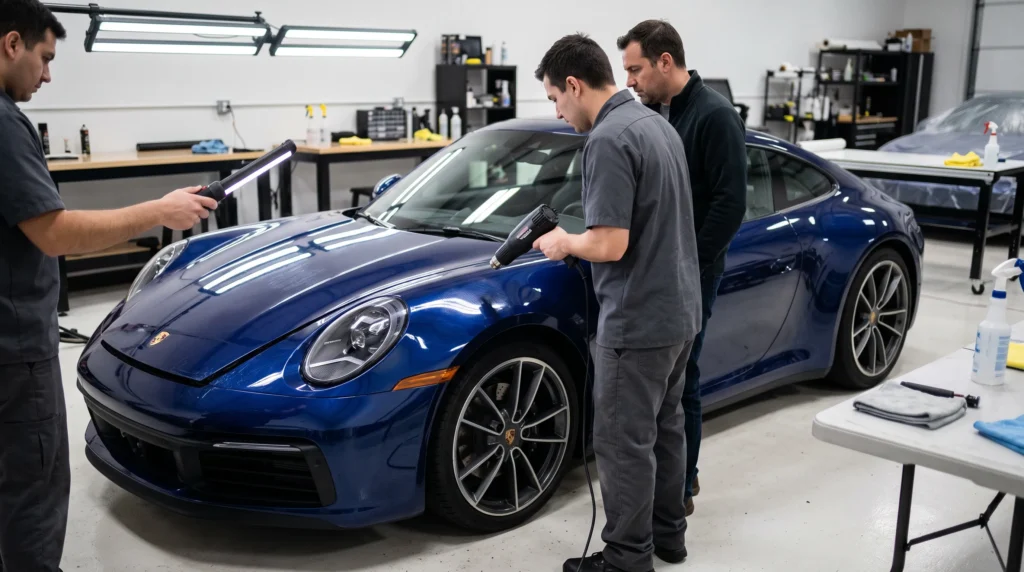
Self-healing does not mean the film can repair every type of damage.
How Does Self-Healing PPF Work?
Modern PPF is built from several layers.
The exact construction depends on the manufacturer and product line, but self-healing films commonly use a top layer designed to respond to warmth.
When a very light scratch or swirl disturbs that upper surface, heat can allow the material to return closer to its original smooth state.
Think about a shallow mark that has changed the surface rather than cut through the film.
As the top coat warms, the material becomes able to relax and level out. The mark then becomes less visible or may disappear.
SunTek describes this as a self-healing surface within its protective top coat.
XPEL describes its products as using elastomeric polymer technology to self-heal minor scratches and swirls.
The exact chemistry varies between films, which is why care instructions for the product installed on your vehicle matter.
Why Heat Helps Light Scratches Disappear
Heat changes how the film’s surface behaves.
A shallow mark may leave the upper layer slightly disturbed. Once warmth reaches the film, the flexible surface can relax and smooth itself.
Manufacturers point to several possible heat sources.
SunTek lists:
- Sunlight
- Warm body panels
- Engine heat
- Warm water
as ways its self-healing surface can respond.
XPEL states that light scratches in several of its current films can self-heal in about 20 to 30 minutes at room temperature and recommends warm water around 120°F when conditions are colder or faster healing is desired.
3M states more broadly that minor scratches can disappear when heat is applied to compatible PPF.
This does not mean more heat is always better.
The manufacturer’s care instructions should guide how the film is treated.
What Types of Marks Can Self-Heal?
Self-healing works best on light surface damage.
That may include:
- Fine wash swirls
- Very light scratches
- Minor surface marks
- Light towel marks
- Fine scuffs affecting only the upper film surface
XPEL states that its paint protection film can self-heal minor scratches and swirl marks.
SunTek describes its self-healing surface as repairing the majority of scratches through heat, but its wording still focuses on the film surface rather than deep structural damage.
This distinction matters.
A light swirl caused by washing is very different from a sharp object cutting deeply through the film.
What Damage Will Not Self-Heal?
Self-healing PPF has limits.
It should not be expected to repair:
- Deep cuts
- Tears
- Punctures
- Film that has been gouged through
- Major rock strikes
- Film that has separated from the panel
- Damaged edges
- Collision damage
- Paint damage underneath the film
XPEL states that deeper scratches that penetrate the film may not heal completely and may require professional repair or film replacement.
That is one of the easiest ways to understand self-healing PPF.
If the surface has only been lightly disturbed, healing may occur.
If the film itself has been physically cut or damaged through its thickness, heat cannot rebuild missing material.
Does Self-Healing Mean the Paint Repairs Itself?
No.
This is one of the most common misunderstandings.
Self-healing technology applies to the PPF surface.
It does not repair factory paint.
If a deep impact passes through the film and damages the clear coat or color coat underneath, heating the PPF will not repair that paint damage.
Likewise, if the vehicle already had a scratch before the PPF was installed, the film does not erase the scratch simply because it has self-healing properties.
That is why the paint should be inspected before film installation.
Some vehicles may benefit from Paint Correction before PPF is installed.
The condition underneath clear film remains visible.
Can Sunlight Activate Self-Healing PPF?
Yes, certain films are designed to respond to warmth from sunlight.
SunTek says the heat of the sun can activate the self-healing surface in its PPF.
XPEL also describes its self-healing top coat as capable of eliminating fine scratches and swirl marks when exposed to the sun.
This means a vehicle may show a few light surface marks after washing and then look better after sitting in warmer conditions.
The effect depends on:
- Film type
- Scratch depth
- Surface temperature
- Outdoor temperature
- Amount of sunlight
A cold cloudy winter day in northern Illinois will not warm the film the same way as direct summer sun.
Can Warm Water Help PPF Heal?
For certain films, yes.
XPEL’s current care instructions state that light scratches in several of its PPF lines can self-heal at room temperature and that warm water at about 120°F can speed the process in colder conditions.
SunTek also identifies warm water as one heat source that can activate its self-healing surface.
The important part is to follow the film manufacturer’s instructions.
Do not assume boiling water or extreme heat is appropriate.
The goal is controlled warmth, not overheating the film, paint, trim, or nearby components.
Can PPF Heal at Room Temperature?
Some products can.
XPEL says light scratches in ULTIMATE PLUS, ULTIMATE FUSION, and STEALTH can self-heal in roughly 20 to 30 minutes at room temperature.
That does not mean every PPF product heals at the same rate.
The film installed on your vehicle may behave differently.
Temperature also matters.
A garage at comfortable indoor temperature provides very different conditions from a vehicle parked outside during a freezing Chicago-area morning.
This is another reason product-specific care instructions matter.
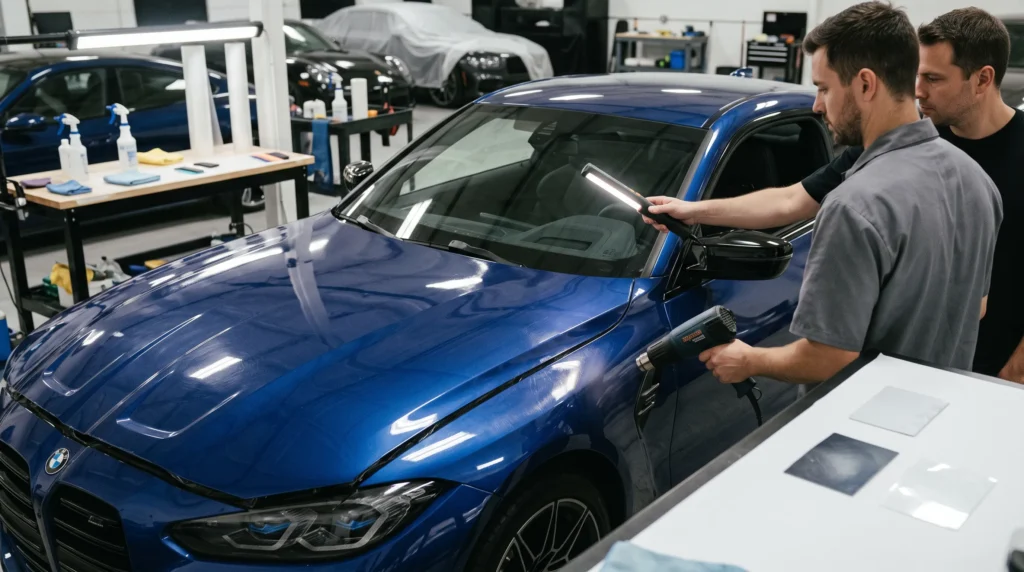
Should You Use a Heat Gun on PPF?
Manufacturer information may mention controlled heat as a way to activate self-healing properties, but a heat gun can create much higher temperatures than warm water or sunlight.
XPEL’s FAQ notes that heat or warm water can activate self-healing for surface scratches, while its consumer care guidance gives warm-water instructions for owners.
For most vehicle owners, following the film maker’s safer consumer-care method makes more sense than experimenting with concentrated heat.
A heat gun placed too close to a surface can create unnecessary risk to:
- Film
- Paint
- Plastic trim
- Rubber seals
- Badges
- Lighting
- Nearby materials
If a scratch is not responding normally, having the film inspected is better than continuing to add heat.
Why Chicago Weather Changes the Healing Process
The self-healing property depends partly on temperature, so weather can change how quickly you see the effect.
Vehicles in Skokie, IL & Chicago’s North Shore can experience very cold winters and warm summers.
During summer, direct sunlight may warm the film enough for minor surface marks to relax naturally.
During winter, film stays much colder.
That can mean self-healing takes longer or needs another approved source of warmth.
The film has not necessarily stopped working simply because a small swirl remains visible on a cold day.
Temperature can be the difference.
Now here’s the thing: if a mark remains after the film warms, the scratch may be deeper than a normal surface swirl.
How Washing Creates Light Swirls in PPF
PPF protects the paint, but the film itself can still pick up light wash marks.
A dirty towel or wash mitt can drag grit across the surface.
Automatic brush washes can also make repeated contact with the film.
XPEL warns that frequent automatic car washes using harsh brushes can potentially damage PPF over time.
Even with self-healing film, careful washing is still worthwhile.
The technology is designed to help with minor marks, not provide permission to scrub the film aggressively.
How to Reduce Swirls in PPF
A few habits can reduce how many light marks reach the film.
Rinse Loose Dirt First
Removing loose grit before touching the surface reduces the amount of abrasive material being moved across the film.
Use Clean Wash Media
A clean microfiber wash mitt or another PPF-safe wash tool is less likely to drag trapped dirt across the vehicle.
Use Clean Towels
Drying towels should be free of debris.
A towel that has fallen on the floor should not go back onto the vehicle.
Avoid Aggressive Brush Washes
XPEL recommends hand washing and notes that harsh automatic brushes can cause damage over time.
Remove Contamination Carefully
Bug residue, bird droppings, road tar, and other contamination should be removed using methods suitable for the film.
Avoid High Pressure at Film Edges
XPEL advises against placing a pressure washer or other high-pressure water source close to film edges because it can contribute to lifting or damage.
Self-healing technology works better as a backup against light wear than as a replacement for good care.
Self-Healing PPF and Rock Chips
Self-healing does not mean a rock chip disappears from the film after sunlight hits it.
There is a difference between a fine surface scratch and a hard impact.
PPF acts as a physical sacrificial layer against road debris.
3M describes its current PPF as being designed to protect painted surfaces from rock chips, scratches, bugs, road tar, stains, and outdoor exposure.
SunTek also markets its PPF as protection against rocks, insects, and road debris.
A stone can strike hard enough to mark or puncture the film.
If that happens, the damaged section should be inspected.
The film may have done its job by taking the impact before the paint did, but self-healing cannot replace material that has been cut away.
Self-Healing PPF and Ceramic Coating
PPF and ceramic coating do different jobs.
PPF is a physical film.
A ceramic coating is a liquid-applied surface treatment.
Applying a compatible coating over PPF can help with water behavior and cleaning, but it does not create the self-healing feature.
That property comes from the film construction itself.
If you are considering both services, The Detail Dynasty offers Ceramic Coating alongside Paint Protection Film.
Film compatibility matters, so any coating placed over PPF should be suitable for that material.
Does All PPF Self-Heal?
No.
Do not assume every paint protection film has identical self-healing behavior.
Different films use different materials, top coats, and product designs.
Current examples include:
- 3M Series 100, which lists self-healing technology for minor scratches when heat is applied
- 3M Series 150, which lists heat-activated self-healing for minor scratches
- SunTek Clear and Matte PPF, which uses a self-healing top coat activated by warmth from the engine or sun
- XPEL ULTIMATE PLUS and related films, which list self-healing behavior for light scratches and swirls
Before installation, ask exactly what film is being used.
The phrase “PPF” by itself does not tell you every feature.
How Long Does Self-Healing Take?
There is no universal time for every film.
XPEL provides one of the clearest current examples, stating that light scratches in several of its films can self-heal in around 20 to 30 minutes at room temperature.
SunTek does not give one fixed time in its FAQ. It explains that heat from the sun, warm water, engine heat, or warm body panels can activate its self-healing surface.
How quickly you see a change can depend on:
- Film brand
- Film series
- Scratch depth
- Surface temperature
- Ambient temperature
- Amount of heat applied
If a mark does not improve under normal approved conditions, it may not be the type of damage self-healing is designed to address.
When Should Damaged PPF Be Inspected?
A light wash swirl does not always need professional attention.
A deeper mark may.
Consider having PPF inspected if you notice:
- A cut through the film
- A deep scratch that stays visible after warming
- Film lifting from an edge
- A puncture
- Major rock-impact damage
- A tear
- Damage after a collision
- Film separating from the painted surface
XPEL recommends contacting an authorized dealer when damage occurs, even when it appears small.
Depending on the damage, one section of film may be replaceable without removing PPF from the entire vehicle.
Self-Healing PPF Explained: What It Can and Cannot Do
The easiest way to understand self-healing PPF is to separate surface wear from physical damage.
Light swirls and minor surface scratches can respond to heat when the film is designed for self-healing.
Sunlight may provide enough warmth.
Some films respond at room temperature.
Warm water can speed the process for certain products.
Deep scratches, tears, punctures, and heavy impacts are different.
Those marks damage more than the flexible upper surface, so heat cannot simply erase them.
Self-healing PPF is useful because normal vehicle ownership can create fine surface marks over time. The technology gives compatible film a way to recover from some of that light wear while the PPF continues protecting the paint underneath.
Schedule PPF in Skokie, IL & Chicago’s North Shore
If you are researching Self-Healing PPF Explained because you are considering paint protection film for your own vehicle, look beyond the words “self-healing.”
Ask which film is being installed, which panels are covered, how the paint will be prepared, and what care the manufacturer recommends.
The Detail Dynasty provides professional Paint Protection Film installation from our dedicated garage facility in Skokie, IL & Chicago’s North Shore.
We also provide:
Call (773) 216-3104 or visit our contact page to schedule an appointment.
Frequently Asked Questions
1. What does self-healing PPF mean?
Self-healing PPF has a surface layer designed to recover from certain minor scratches and swirl marks when the film warms. Heat allows the compatible surface to relax and smooth out. It does not mean all film damage repairs itself.
2. Can sunlight remove scratches from PPF?
For certain self-healing films, yes. SunTek and XPEL both describe sunlight or solar heat as capable of activating self-healing behavior for light surface scratches.
3. Does warm water help self-healing PPF?
It can for compatible products. XPEL recommends warm water at about 120°F to speed self-healing in colder conditions for several of its PPF products. SunTek also identifies warm water as a source of heat for its self-healing surface.
4. Can self-healing PPF fix deep scratches?
No. XPEL states that deeper scratches penetrating the film may not fully heal and can require professional repair or replacement.
5. How long does self-healing PPF take to remove light swirls?
It depends on the film and temperature. XPEL states that light scratches in several of its PPF products can self-heal in about 20 to 30 minutes at room temperature. Colder conditions may slow the process.
6. Does self-healing PPF repair scratched paint underneath?
No. Self-healing applies to the film surface, not damaged automotive paint. Existing paint defects may need Paint Correction before clear PPF is installed.
7. Where can I get self-healing PPF installed near Chicago?
The Detail Dynasty provides professional Paint Protection Film installation from our dedicated facility in Skokie, IL & Chicago’s North Shore. Call (773) 216-3104 or visit our contact page to schedule an appointment.
Sources
- Answers to Your Paint Protection Film Questions
Publisher: SunTek
Publication Date: Not listed, accessed October 2026
Used for: Self-healing top-coat behavior and the use of sunlight, warm panels, engine heat, and warm water to activate surface healing. - XPEL Product Care Instructions
Publisher: XPEL
Publication Date: Current page accessed October 2026
Used for: Room-temperature self-healing, 20-to-30-minute healing guidance, warm-water instructions, washing, pressure-washer precautions, and inspection guidance. - 3M Paint Protection Film Series 150 Gloss Technical Data Sheet
Publisher: 3M
Publication Date: March 2024
Used for: Heat-activated self-healing of minor scratches and PPF protection against stone chips, scratches, road tar, stains, bugs, UV exposure, and outdoor weather. - 3M Paint Protection Film Series 100
Publisher: 3M
Publication Date: Not listed, accessed October 2026
Used for: Self-healing technology and heat-assisted removal of minor scratches and marks. - XPEL Frequently Asked Questions
Publisher: XPEL
Publication Date: Current page accessed October 2026
Used for: Self-healing minor scratches and swirls, limitations of healing deeper scratches, and film-care information. - SunTek Paint Protection Film Clear and Matte
Publisher: SunTek
Publication Date: Not listed, accessed October 2026
Used for: Self-healing top coat and use of engine or solar heat for light surface scratches.
