

How Long Does Paint Protection Film Last on Chicago-Area Cars? A quality PPF installation commonly has a service life in the range of 5 to 10 years, but the actual lifespan depends on the film, installation, mileage, road exposure, storage, washing habits, and weather conditions. Chicago-area vehicles deal with winter road treatments, summer sun, highway debris, bugs, and large temperature swings, so two cars with the same film may not age at the same rate.
XPEL states that paint protection film typically lasts between 5 and 10 years, with film quality, installation, climate, road conditions, driving habits, mileage, and maintenance all affecting durability. Many current premium PPF products also carry manufacturer warranties lasting up to 10 years. XPEL’s PPF FAQ and 3M’s Paint Protection Film Series 150 provide examples of these lifespan and warranty ranges.
The Detail Dynasty installs Paint Protection Film from our dedicated automotive protection facility in Skokie, IL & Chicago’s North Shore. If you are trying to decide whether PPF makes sense for a daily driver in the Chicago area, understanding what affects film life is more useful than focusing on one promised number.
Table of Contents
- How Long Does Paint Protection Film Usually Last?
- Why Chicago-Area Cars Can Be Hard on PPF
- How Winter Road Salt Affects PPF
- Does Highway Driving Shorten PPF Life?
- How Sun Exposure Affects PPF
- Does Garage Storage Help PPF Last Longer?
- How Washing Habits Affect PPF Life
- Why Installation Quality Matters
- Does PPF Brand Matter?
- Does Full-Front PPF Wear Faster Than Full-Body PPF?
- Signs Your PPF May Need Replacement
- Can One Damaged PPF Panel Be Replaced?
- Does Ceramic Coating Help With PPF Care?
- How to Help PPF Last Longer
- Schedule PPF Near Chicago
- Frequently Asked Questions
How Long Does Paint Protection Film Usually Last?
For modern quality film, 5 to 10 years is a useful general range.
XPEL currently states that PPF typically lasts between 5 and 10 years. The manufacturer points to film quality, installation technique, environmental conditions, driving style, road conditions, maintenance, climate, and mileage as factors that affect service life. XPEL PPF FAQ
3M’s current Series 150 PPF carries a 10-year consumer warranty under the manufacturer’s stated conditions. 3M also describes the film as being made to protect vehicle paint from stone chips, scratches, bugs, road tar, stains, salt, UV exposure, and outdoor weather. 3M Paint Protection Film Series 150
A warranty period and actual service life are related, but they are not exactly the same thing.
A film can suffer physical damage from a rock strike long before it becomes old. Another vehicle may reach many years of use with the film still looking good.
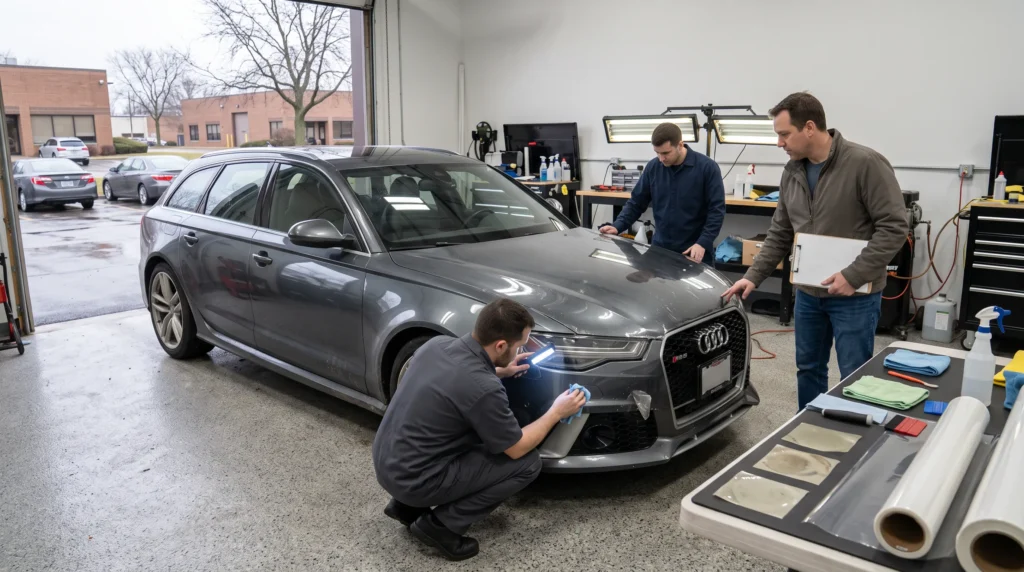
The better question is:
How is this specific car being used and cared for?
Why Chicago-Area Cars Can Be Hard on PPF
Chicago-area vehicles can see a broad range of conditions within one year.
Winter can bring:
- Snow
- Ice
- Road salt
- Salt brine
- Slush
- Sand and roadway grit
- Freezing temperatures
Warmer months can bring:
- Strong sunlight
- Bugs
- Road tar
- Construction debris
- Dust
- Long highway trips
A commuter that spends several hours each week on major roads may put much more stress on front-end film than a vehicle that travels short local distances and stays indoors overnight.
That does not mean PPF cannot hold up well in northern Illinois.
It means the environment should be part of your expectations when asking how long paint protection film lasts on Chicago-area cars.
How Winter Road Salt Affects PPF
Winter road treatment is a real factor around Illinois.
The Illinois Department of Transportation states that it primarily uses rock salt along with liquid treatments such as salt brine for winter road operations. Salt and brine are used to help prevent or remove snow and ice on state-maintained roads. IDOT Winter Road Conditions
That means a Chicago-area daily driver can repeatedly encounter salty spray and dirty winter slush.
Modern PPF is made for exterior automotive exposure. 3M even lists salt among the conditions its Series 150 film is designed to protect against. 3M Series 150
Still, leaving winter residue on a vehicle for long periods is not a good maintenance plan.
Wash Winter Residue Off the Film
During winter, regular cleaning can help keep salt, grime, and road residue from sitting on the PPF.
Pay attention to:
- Front bumper
- Rocker areas
- Lower doors
- Wheel-arch areas
- Rear bumper
- Lower quarter panels
If your vehicle has only full-front PPF, wash the rest of the vehicle carefully too. Film protects covered paint, but uncovered surfaces still need normal care.
Does Highway Driving Shorten PPF Life?
Mileage can affect how fast film shows wear.
XPEL lists mileage, driving style, and road conditions among the factors affecting PPF longevity. XPEL FAQ
That makes sense when you consider what happens at highway speed.
The front bumper, hood, mirrors, and fenders can face repeated contact with:
- Small stones
- Road grit
- Bugs
- Tire debris
- Construction material
- Winter spray
A vehicle that travels thousands of highway miles each year may put more wear on front-end PPF than a weekend vehicle driven only occasionally.
This is also why full-front PPF is commonly considered by commuters. It places the protective film over the forward-facing painted panels that regularly encounter road debris.
PPF acts as the sacrificial surface. Damage to the film can mean it has taken an impact that otherwise would have reached the paint.
How Sun Exposure Affects PPF
UV exposure is another part of film aging.
Current premium films are designed to tolerate outdoor exposure. 3M describes its Series 150 PPF as being made for exposure to harsh ultraviolet radiation and outdoor weathering.
XPEL also describes its current PPF products as having resistance to yellowing from UV exposure. XPEL Paint Protection Film
That does not make storage conditions irrelevant.
A vehicle sitting outdoors every day receives much more sunlight than a car parked inside a garage for most of its life.
The film is designed for outdoor use, but reducing constant exposure can still be easier on the vehicle as a whole.
Does Garage Storage Help PPF Last Longer?
Garage storage can reduce exposure to sun, weather, bird residue, tree sap, falling debris, and other contaminants.
3M recommends storing wrapped vehicles indoors when possible and keeping them regularly cleaned to help protect the appearance and service life of automotive films. 3M Auto Films Support
A garage is not required for PPF.
Many vehicles protected with film live outside.
It simply changes how much environmental exposure the car receives.
Consider two identical cars.
One sits outside every day and travels long distances year-round.
The other stays in a garage at home and sees fewer miles.
Even with the same film and installer, you should not expect both pieces of PPF to age at exactly the same speed.
How Washing Habits Affect PPF Life
Cleaning methods can play a large role in how film looks over time.
XPEL recommends hand washing and notes that repeated automatic washes with harsh brushes can potentially damage film over time. The manufacturer also identifies regular maintenance as one factor affecting PPF lifespan. XPEL FAQ
For a Chicago-area vehicle, consistent washing becomes even more useful during winter.
Be Careful Around Film Edges
High-pressure water should not be aggressively directed into film edges.
A professional installation is designed to stay attached during normal use and cleaning, but repeatedly attacking an edge at close range with strong pressure is unnecessary.
Remove Contaminants Before They Sit Too Long
Try not to leave the following on the film for long periods:
- Bird residue
- Bug remains
- Tree sap
- Road tar
- Winter grime
Clean them using methods and products that are suitable for the PPF installed on the vehicle.
Why Installation Quality Matters
The film itself is only part of the equation.
XPEL includes installation technique among the factors that influence PPF longevity.
Proper installation involves:
- Surface preparation
- Careful film placement
- Correct stretching
- Managing contours
- Finishing edges
- Inspecting the completed panels
A bumper can have tight curves, vents, cameras, sensors, grilles, and openings.
A hood is much simpler by comparison.
Different panels place different demands on the material.
The Detail Dynasty performs PPF work in a dedicated garage facility in Skokie, IL & Chicago’s North Shore, where the vehicle can be prepared and protected in a controlled indoor setting.
Does PPF Brand Matter?
Film quality matters.
Modern PPF products differ in:
- Topcoat construction
- Thickness
- Adhesive
- Clarity
- Stain resistance
- Surface finish
- Self-healing behavior
- Warranty terms
That is why a lifespan estimate should be tied to the exact film.
For reference, both 3M and XPEL currently offer qualifying PPF products with 10-year manufacturer warranty periods.
A long warranty should still be read carefully.
Check:
- What defects are covered
- Whether professional installation is required
- Whether registration is needed
- What care rules apply
- What exclusions exist
A warranty against yellowing or delamination is not the same as a guarantee against every rock strike or collision.
Does Full-Front PPF Wear Faster Than Full-Body PPF?
The front of a vehicle often receives more direct road exposure.
That means front bumper and hood film may experience more impacts than film on a roof or upper door.
With full-body PPF, every covered panel uses protective film, but that does not mean every panel ages at the same pace.
The bumper may see repeated impacts while a rear door sees relatively little.
This can matter years later.
You might eventually need one damaged panel replaced while the remaining film stays in place.
Signs Your PPF May Need Replacement
PPF does not always need replacement simply because it has reached a certain birthday.
Look at its condition.
Possible reasons to have film inspected include:
- Lifting edges
- Cracking
- Blistering
- Delamination
- Heavy staining
- Major impact damage
- Deep cuts through the film
- Appearance changes
- Damage from an accident or body repair
Some of these conditions may relate to physical damage rather than old age.
Manufacturer warranties may cover certain film failures under their written terms. XPEL, as one reference, lists yellowing, cracking, blistering, and delamination among conditions covered by qualifying 10-year limited PPF warranties.
Can One Damaged PPF Panel Be Replaced?
Often, yes.
PPF is normally installed by panel or section.
If one door, bumper, or fender suffers damage, the film on that area may be removable and replaceable without stripping film from the entire vehicle.
XPEL notes that individual panels can be replaced, though older film may have a slightly different appearance from newly installed material due to climate, storage, driving, and maintenance history. XPEL FAQ
This is useful for long-term ownership.
A single damaged area does not automatically mean restarting the whole PPF installation.
Does Ceramic Coating Help With PPF Care?
PPF and ceramic coating perform different jobs.
PPF provides a physical film over the paint.
Ceramic coating is a liquid-applied surface treatment.
Some ceramic coatings can be applied over compatible PPF to make cleaning easier and add water-repelling surface behavior.
XPEL states that compatible ceramic coating can be applied to its PPF and says its FUSION PLUS coating does not void the company’s PPF warranty. XPEL FAQ
If you are interested in using both, The Detail Dynasty offers Ceramic Coating along with PPF.
The film and coating should be treated as separate products with separate roles.
How to Help PPF Last Longer
There is no way to control every rock, winter storm, or construction zone around Chicago.
You can control how you care for the film.
Wash the Vehicle Regularly
Do not let winter salt, bugs, bird residue, or road grime stay on the surface longer than necessary.
Use PPF-Safe Cleaning Methods
Follow the care instructions provided for your exact film.
Be Careful With High-Pressure Washing
Keep pressure-washer nozzles at a sensible distance and avoid directing high pressure directly into film edges.
Avoid Harsh Brush Washes
Repeated contact from aggressive automatic car-wash brushes can add wear to the film.
Store Indoors When Possible
Garage storage reduces continuous weather and UV exposure.
Inspect the Film
Look over the bumper, hood, mirrors, rocker panels, and film edges during washes.
If something starts lifting or gets damaged, having it checked earlier can prevent the area from becoming worse.
Know What Your Warranty Covers
Keep the film and installation paperwork.
If your PPF has a manufacturer warranty, know the term and conditions before an issue appears.
How Long Does Paint Protection Film Last on Chicago-Area Cars in Real Life?
For many quality PPF products, 5 to 10 years is a reasonable general lifespan range, with some current premium films backed by 10-year manufacturer warranties.
Chicago-area conditions can affect where your vehicle falls within that range.
A car that sees long highway commutes, winter salt, outdoor parking, and frequent automatic brush washes may put more stress on film.
A garage-kept vehicle that receives regular care and fewer miles may age differently.
There is no single replacement date that applies to every vehicle.
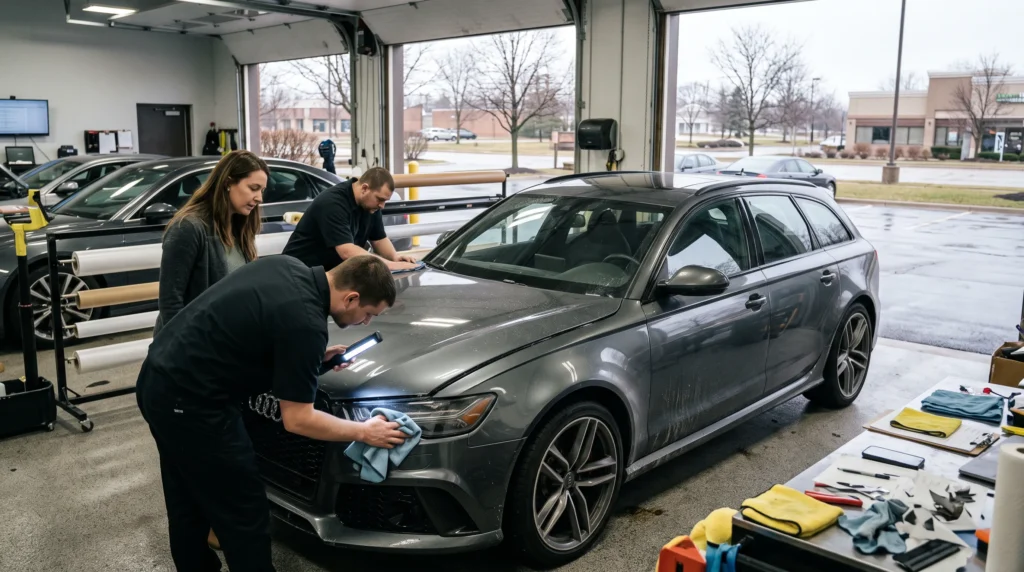
Film quality, installation, road exposure, mileage, storage, and maintenance all matter.
Schedule PPF Near Chicago
If you are asking how long paint protection film lasts on Chicago-area cars because you are considering PPF for your own vehicle, start with the coverage you want and how you use the car.
The Detail Dynasty provides professional Paint Protection Film installation from our dedicated facility in Skokie, IL & Chicago’s North Shore.
We also provide:
Call (773) 216-3104 or visit our contact page to schedule an appointment and discuss PPF coverage for your vehicle.
Frequently Asked Questions
1. How long does paint protection film last on Chicago-area cars?
Quality PPF commonly lasts around 5 to 10 years. Film quality, installation, climate, road conditions, mileage, storage, and maintenance can all affect lifespan. XPEL currently identifies 5 to 10 years as a typical range for PPF.
2. Does Chicago winter salt damage PPF?
Quality automotive PPF is designed for outdoor road conditions, and 3M lists salt among the hazards its Series 150 film is made to protect against. Regular washing is still a good idea because Illinois roads receive rock salt and liquid winter treatments.
3. Does PPF last 10 years?
Some premium PPF products carry 10-year manufacturer warranties. That does not mean every piece of film will remain untouched for exactly 10 years. Physical impacts, maintenance, mileage, storage, and environmental exposure affect real-world service life.
4. Can PPF be replaced before the warranty ends?
Yes. Film may be replaced after physical damage, body repair, appearance changes, or another reason unrelated to age. Individual protected panels can often be removed and reinstalled without replacing PPF across the whole vehicle.
5. Does parking outside shorten PPF life?
Constant outdoor storage increases exposure to sunlight, weather, bird residue, tree sap, and other contaminants. PPF is designed for outdoor automotive use, but indoor storage reduces some of that exposure.
6. Will automatic car washes damage paint protection film?
XPEL states that frequent automatic washes using harsh brushes can potentially damage PPF over time and recommends hand washing, with touchless washing also identified as an option for its films. Follow the care directions for your specific PPF.
7. Where can I get PPF installed in the Chicago area?
The Detail Dynasty provides professional Paint Protection Film installation from our dedicated garage facility in Skokie, IL & Chicago’s North Shore. Call (773) 216-3104 or visit our contact page to schedule an appointment.
Sources
- Frequently Asked Questions
Publisher: XPEL
Publication Date: Not listed, accessed October 2026
Used for: Typical 5-to-10-year PPF lifespan, maintenance, mileage, driving conditions, storage factors, washing guidance, panel replacement, and ceramic coating compatibility. - 3M Paint Protection Film Series 150
Publisher: 3M
Publication Date: Not listed, accessed October 2026
Used for: 10-year consumer warranty, resistance to salt, stone chips, scratches, road tar, UV exposure, stains, bugs, and outdoor weather. - Winter Road Conditions and Road Salting
Publisher: Illinois Department of Transportation
Publication Date: Current page accessed October 2026
Used for: Illinois use of rock salt, salt brine, and other liquid treatments during winter road operations. - 3M Auto Films Support
Publisher: 3M
Publication Date: Not listed, accessed October 2026
Used for: Indoor storage and regular cleaning guidance for automotive films and information about warranty periods. - XPEL Paint Protection Film
Publisher: XPEL
Publication Date: Not listed, accessed October 2026
Used for: Current PPF self-healing, UV resistance, edge-seal, and 10-year warranty information.
