

Window Tinting in Palatine, IL can make a daily driver more comfortable by reducing solar heat, glare, and UV exposure while giving the vehicle a cleaner, more private appearance. Once you decide to tint your windows, another question usually follows: should you choose ceramic tint or carbon tint?
Both film types can work well on a vehicle that sees daily use. The biggest differences come down to film construction, infrared heat control, appearance, and what you expect from your tint during commuting, errands, highway driving, and long periods parked outside.
At The Detail Dynasty, we install automotive window tint from our dedicated garage facility in Skokie, IL & Chicago’s North Shore. If you drive from Palatine and want to understand the difference between ceramic and carbon window film before choosing a shade, this guide walks through what matters.
Table of Contents
- What Is Automotive Window Tint?
- Why Palatine Daily Drivers Choose Window Tint
- What Is Carbon Window Tint?
- What Is Ceramic Window Tint?
- Ceramic vs Carbon Tint at a Glance
- Which Film Rejects More Heat?
- Does Ceramic Tint Need to Be Dark to Block Heat?
- Carbon Tint for Daily Driving
- Ceramic Tint for Daily Driving
- UV Protection and Interior Care
- Glare and Driving Comfort
- Electronic Signal Compatibility
- Choosing a Window Tint Shade
- Illinois Window Tint Rules
- Ceramic or Carbon Tint for Your Vehicle?
- Tesla Window Tint Near Palatine
- Why Professional Tint Installation Matters
- Schedule Window Tinting Near Palatine
- Frequently Asked Questions
What Is Automotive Window Tint?
Automotive window tint is a thin film installed on vehicle glass to change the amount of visible light and solar energy that passes into the cabin.
Depending on the film, tint can help with:
- Solar heat reduction
- Glare reduction
- UV protection
- Added privacy
- A darker exterior appearance
- Cabin comfort
- Interior protection from sun exposure
The film type matters because two tints with a similar shade can behave very differently when exposed to sunlight.
One may look dark but offer moderate heat control. Another may look lighter while rejecting more infrared energy.
That is why drivers shopping for Window Tinting in Palatine, IL should look beyond shade alone.
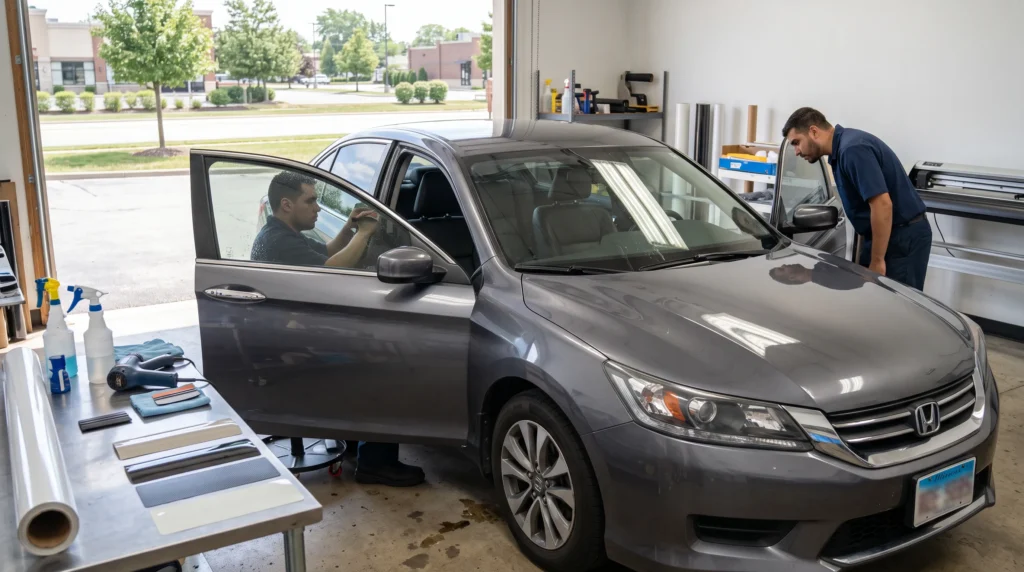
The Detail Dynasty offers professional Window Tint installation for drivers who want to compare film choices before scheduling their vehicle.
Why Palatine Daily Drivers Choose Window Tint
Daily driving exposes your vehicle to changing sunlight throughout the day.
Your car may sit outside while you are at work, spend time in traffic, travel on highways, or stay parked in an open lot while you shop or run errands.
Sunlight entering through automotive glass can raise cabin temperatures and create glare.
Window tint can reduce some of that solar exposure.
For a daily driver, a good tint choice should balance several goals:
- Heat control
- Visibility
- Privacy
- Glare reduction
- Appearance
- Legal light transmission
- Nighttime driving comfort
This is where the ceramic versus carbon discussion becomes useful.
Both can be good choices. They simply approach solar control differently.
What Is Carbon Window Tint?
Carbon window tint uses carbon-based material within the film construction.
SunTek describes its Carbon Series as a film built with carbon technology for heat rejection, glare reduction, and UV protection. The manufacturer also describes the film as having a nonreflective black appearance.
Source: SunTek Carbon Tint.
Carbon films became popular with drivers who wanted something beyond a simple dyed tint.
What Carbon Tint Can Offer
Depending on the exact product, carbon tint may provide:
- A dark, nonreflective appearance
- Heat rejection
- UV protection
- Glare reduction
- Color stability
- Signal-friendly construction
- Several shade choices
Carbon tint does not need metallic material to produce its appearance.
That can be useful in modern vehicles where drivers rely on phones, Bluetooth devices, GPS, satellite radio, and other wireless systems.
Carbon Film Appearance
Carbon tint often has a neutral dark or black appearance.
For many daily drivers, that creates the look they want without an overly reflective finish.
The exact color can vary between manufacturers and film lines.
If appearance matters to you, looking at film samples before installation can help you compare how each shade looks under natural light.
What Is Ceramic Window Tint?
Ceramic window tint uses very small ceramic particles within the film.
SunTek states that its ceramic CIR Series uses ceramic nanoparticles to increase heat and infrared rejection while keeping a non-metal construction.
Source: SunTek CIR Ceramic Window Tint.
Ceramic films are commonly chosen by drivers who place a strong focus on heat control.
What Ceramic Tint Can Offer
Depending on the film line, ceramic tint may provide:
- Strong infrared heat rejection
- Solar-energy rejection
- UV protection
- Glare reduction
- Non-metal construction
- Clear electronic signal use
- Multiple VLT shades
- Heat control without needing extremely dark glass
This last point matters for a daily driver.
A driver may want strong heat rejection but still prefer a lighter shade for visibility or appearance.
Ceramic technology can make that combination possible.
Ceramic vs Carbon Tint at a Glance
Here is a simple comparison of the two film types.
| Feature | Carbon Tint | Ceramic Tint |
|---|---|---|
| Film construction | Carbon-based | Ceramic nanoparticle-based |
| Heat rejection | Good to strong, depending on product | Often stronger, depending on product |
| Infrared control | Varies by film line | Often a major focus |
| UV protection | Common | Common |
| Non-metal options | Yes | Yes |
| Signal-friendly | Common | Common |
| Appearance | Dark, nonreflective | Often neutral and nonreflective |
| Shade choices | Multiple | Multiple |
| Good for daily drivers | Yes | Yes |
| Strong choice for heat-focused drivers | Can be | Often |
These are broad differences.
The specifications of the exact film matter more than the category name.
A high-performing carbon film can beat a lower-performing product from another film family in certain measurements.
Always compare the data for the film being offered.
Which Film Rejects More Heat?
Ceramic tint is often built with stronger infrared and solar heat control than standard carbon film.
SunTek describes its Carbon Series as providing good heat rejection. Its CXP carbon-based film is designed for stronger infrared rejection than its standard Carbon Series.
The company’s ceramic CIR film uses ceramic nanoparticles for higher heat and infrared control.
Source: SunTek Automotive Window Tint.
This does not mean every ceramic film automatically rejects more heat than every carbon film.
Film lines differ.
Here’s what matters: compare the exact specifications rather than choosing from the word “ceramic” or “carbon” alone.
Look for measurements such as:
- Visible Light Transmittance
- Total Solar Energy Rejection
- Infrared Energy Rejection
- UV protection
- Visible light reflection
- Glare reduction
Those figures provide a clearer picture of what the film does.
Does Ceramic Tint Need to Be Dark to Block Heat?
No.
Darkness and heat rejection are not the same thing.
Tint darkness is usually described through Visible Light Transmittance, or VLT.
A lower VLT number allows less visible light through.
A higher VLT number allows more visible light through.
Heat rejection is measured separately.
That means a lighter ceramic film may offer stronger heat control than a darker film built with different materials.
This distinction can be helpful for Palatine daily drivers who want heat reduction without extremely dark windows.
You can choose a shade around your visibility, appearance, and Illinois legal requirements while still looking for strong solar control.
Carbon Tint for Daily Driving
Carbon tint can be a good match for a driver who wants a darker appearance, heat reduction, glare control, and UV protection without moving to a higher-tier ceramic film.
For a daily-use car, those features can cover a lot of what drivers want from tint.
Carbon Tint May Fit You If:
- You want a clean black appearance
- You want better heat control than a simple dyed film
- You want glare reduction
- You want UV protection
- You want a non-metal film
- You want several shade options
- Extreme infrared rejection is not your biggest concern
Carbon tint can make sense for commuter cars, family vehicles, SUVs, trucks, and other vehicles used throughout the week.
The catch is that carbon film performance varies.
A film labeled carbon should still be judged by its published specifications.
Ceramic Tint for Daily Driving
Ceramic tint may fit drivers who spend a lot of time in their vehicles and want stronger solar and infrared control.
Think about a car that sits outside during work hours.
When you return after several hours of sun exposure, the glass has allowed solar energy into the cabin.
Window tint cannot stop every source of heat, but a higher-performing ceramic film can reduce the amount of solar energy entering through the treated glass.
Ceramic Tint May Fit You If:
- Heat rejection is a major concern
- You spend a lot of time commuting
- Your vehicle regularly sits outdoors
- You want strong infrared control
- You want a lighter tint with strong solar performance
- You want a non-metal film
- You use wireless electronics throughout the vehicle
Ceramic tint can also work well on vehicles with large glass areas.
More glass means more surface area exposed to sunlight.
UV Protection and Interior Care
Both carbon and ceramic films can provide strong UV protection when you select a quality automotive film.
SunTek states that qualifying films in its range provide 99% or greater UV protection across the manufacturer’s stated UV wavelength range.
Source: SunTek Carbon Tint.
The manufacturer also states that its CIR ceramic film blocks 99% of damaging UV rays.
Source: SunTek CIR Ceramic Window Tint.
Reducing UV exposure can also help limit sun exposure to interior surfaces such as:
- Leather
- Upholstery
- Dashboard materials
- Door panels
- Trim
Tint should not be treated as a guarantee against all interior aging. Heat, use, cleaning products, and time also affect interior materials.
Still, UV reduction is a useful benefit for a vehicle that spends years being driven and parked outdoors.
Glare and Driving Comfort
Glare can become tiring during daily driving.
Bright sunlight through side windows can reflect across:
- Mirrors
- Instrument panels
- Navigation screens
- Glossy trim
- Other vehicles
Both ceramic and carbon tint can reduce visible light and glare.
The amount depends partly on the shade.
A darker tint generally reduces more visible light, but darker is not always better for every driver.
A very dark film may feel comfortable in bright daylight while making it harder to see through the glass at night.
Daily drivers should think about both conditions.
If you leave for work before sunrise or regularly return home after dark, nighttime visibility deserves attention when selecting VLT.
Electronic Signal Compatibility
Many drivers remember older stories about metallic window film interfering with electronics.
Modern non-metal carbon and ceramic films avoid that concern.
SunTek describes both its carbon and ceramic options as signal-friendly or non-metal products.
That can matter in vehicles using:
- Smartphones
- Bluetooth
- GPS
- Satellite radio
- Connected vehicle systems
- Wireless accessories
For most modern daily drivers, non-metal film is an easy choice when you want to avoid putting a metal-based layer around vehicle glass.
Choosing a Window Tint Shade
Film type answers one question.
Shade answers another.
Common tint levels may include:
- 70%
- 50%
- 35%
- 20%
- 5%
The percentage refers to visible light transmission.
70% Tint
A 70% film looks light.
It can be used when a driver wants minimal visual darkening while still taking advantage of the solar-control properties available in that film.
50% Tint
A 50% tint creates a light shaded appearance.
It allows much more visible light through than darker options while still changing the character of the glass.
35% Tint
A 35% tint creates a more noticeable tinted appearance.
Many drivers like this range because it darkens the windows without producing the same appearance as much lower VLT films.
20% Tint
A 20% film looks considerably darker.
It provides more privacy but also reduces the visible light passing through the treated glass.
5% Tint
A 5% tint allows very little visible light through.
It creates a very dark appearance and can reduce outward visibility at night.
Not every shade is legal on every window in Illinois.
That brings us to the next part.
Illinois Window Tint Rules
Illinois window tint law is more detailed than choosing one legal percentage for the entire vehicle.
Under 625 ILCS 5/12-503, Illinois generally does not allow tint across the entire front windshield.
A nonreflective tint strip may be used along the uppermost portion of the windshield as long as it does not extend more than six inches down from the top.
The statute also sets rules for the windows directly beside the driver.
One permitted setup allows at least 50% light transmittance on the windows immediately beside the driver when none of the windows behind the driver’s seat are treated below 30% light transmittance. The statute includes a 5% enforcement variance when measured by law enforcement.
Another permitted setup allows at least 35% light transmittance on the windows beside the driver when none of the rear windows are treated below 35% light transmittance, again subject to the conditions stated in the law.
Vehicles with certain factory-tinted rear glass are addressed separately within the statute.
Illinois also lists exemptions for qualifying medical conditions.
Because the legal setup depends on the vehicle and which windows are treated, check the current statute before choosing your film.
This article provides general information and is not legal advice.
Ceramic or Carbon Tint for Your Vehicle?
The choice becomes easier once you decide what matters most to you.
Choose Carbon Tint When:
You want a clean appearance, useful heat rejection, glare reduction, UV protection, and a non-metal film for everyday use.
Carbon can make sense when you want a step above simple dyed tint without making maximum infrared control your main goal.
Choose Ceramic Tint When:
You put more weight on heat and infrared rejection.
Ceramic can also be appealing when you want a lighter visible shade without giving up as much solar-control ability.
Now here’s the thing: the film label alone is not enough.
Ask for specifications.
Compare the VLT and solar-energy data for the exact shade being installed.
A daily driver spends too much time on the road to choose tint based only on how dark a sample looks.
Ceramic Tint, Carbon Tint, and Your Driving Habits
Think about a normal week with your vehicle.
Does your car spend hours parked outside?
Do you commute during the brightest part of the day?
Do you frequently use your vehicle after dark?
Do you carry children or passengers in the rear seats?
Do you prefer privacy?
Is cabin heat the biggest problem?
Do you want your windows to look dark, or do you prefer a lighter factory-style appearance?
Your answers can help narrow the choice.
A Palatine driver who spends long stretches commuting and parking outdoors may place more weight on ceramic film.
Someone who wants a dark, nonreflective look with good heat control may be happy with carbon film.
Neither choice needs to be made from the film name alone.
Tesla Window Tint Near Palatine
Tesla vehicles often have large glass areas, so film choice can have a noticeable effect on cabin feel and appearance.
The Detail Dynasty offers dedicated Tesla Window Tint services.
Cybertruck owners can also review our Cybertruck Window Tint page.
Tesla owners considering more exterior protection can review:
Your Tesla model, glass layout, desired shade, and heat-control goals should all be discussed before film is selected.
Why Professional Tint Installation Matters
Good window film still needs good installation.
Vehicle glass may look simple from a distance, but tint installers work around curved glass, seals, trim, defroster lines, tight edges, and moving side windows.
Glass also needs careful preparation before the film goes on.
Contamination between the film and glass can leave visible spots or imperfections.
At The Detail Dynasty, window tint is installed at our dedicated garage facility in Skokie, IL & Chicago’s North Shore.
Working indoors gives our team a controlled place to prepare the vehicle and install the film.
Professional installation also gives you a chance to compare:
- Carbon vs ceramic film
- Tint shades
- Visible light transmission
- Heat rejection
- Privacy
- Glare control
- Illinois tint rules
- Vehicle-specific glass
If you are planning more work on the vehicle, you can also review our Paint Protection Film, Ceramic Coating, Paint Correction, Vinyl Wrap, and Auto Detailing services.
Window Tinting in Palatine, IL: Which Film Fits a Daily Driver?
For most daily drivers, the choice between ceramic and carbon tint comes down to how much weight you place on heat rejection.
Carbon tint can provide good heat control, glare reduction, UV protection, and a clean nonreflective appearance.
Ceramic tint usually puts more emphasis on infrared and solar-energy control.
If your car spends a lot of time outside or you simply want stronger heat rejection, ceramic film deserves a close look.
If you want solid everyday solar protection with a dark, nonreflective appearance, carbon film may suit what you are after.
Shade comes next.
A 35% ceramic film and a 35% carbon film may appear similar from outside while producing different heat-rejection measurements.
That is why Window Tinting in Palatine, IL should be chosen by film specifications and daily use rather than shade alone.
Schedule Window Tinting Near Palatine
If you are comparing ceramic and carbon Window Tinting in Palatine, IL, The Detail Dynasty can help you review the available film and shade choices for your vehicle.
Our automotive detailing and protection studio is located in Skokie, IL & Chicago’s North Shore.
Tell us what you drive, how you use it, and whether your biggest concern is heat, glare, privacy, UV exposure, or appearance.
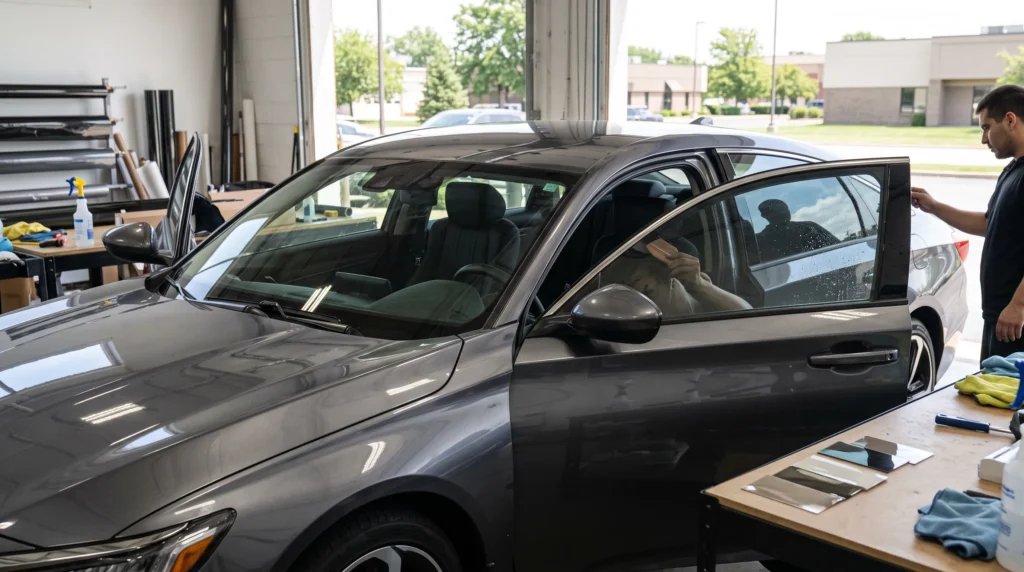
Call (773) 216-3104 or visit our contact page to schedule an appointment.
Frequently Asked Questions
1. Is ceramic tint better than carbon tint for heat?
Ceramic films are often designed for stronger infrared and solar heat rejection than standard carbon films. The exact result depends on the product, so compare the specifications for the exact ceramic and carbon films you are considering.
2. Is carbon window tint good for a daily driver?
Yes. Carbon film can offer heat reduction, UV protection, glare control, privacy, and a nonreflective appearance. It can work well for commuters and vehicles used throughout the week.
3. Does ceramic tint have to be darker to block more heat?
No. Tint darkness measures visible light transmission, while heat rejection is measured separately. A lighter ceramic film can provide stronger heat control than a darker film with a different construction.
4. Does ceramic window tint interfere with GPS or phone signals?
Many ceramic automotive films use non-metal construction. SunTek describes its CIR ceramic film as non-metal and designed to maintain clear communications. Check the construction of the exact product before installation.
5. Does carbon tint turn purple over time?
Quality carbon film is designed for color stability. SunTek states that its Carbon and CXP lines carry warranty protection against color change, subject to the manufacturer’s warranty conditions.
6. What tint percentage should I choose in Illinois?
There is no single percentage that applies to every window and every vehicle configuration. Illinois Vehicle Code Section 12-503 sets different conditions based on window location and rear-window treatment. Review the current law before selecting your setup.
7. Where can I get Window Tinting near Palatine, IL?
The Detail Dynasty provides professional Window Tint installation from our dedicated garage facility in Skokie, IL & Chicago’s North Shore. Palatine vehicle owners can call (773) 216-3104 or visit our contact page to schedule an appointment.
Sources
- SunTek Carbon Tint
Publisher: SunTek
Publication Date: Not listed
Used for: Carbon film construction, heat rejection, UV protection, glare reduction, nonreflective appearance, signal compatibility, and color stability. - SunTek CIR Ceramic Window Tint
Publisher: SunTek
Publication Date: Not listed
Used for: Ceramic nanoparticle construction, infrared and heat rejection, UV protection, non-metal design, and signal compatibility. - SunTek Automotive Window Tint
Publisher: SunTek
Publication Date: Not listed
Used for: Comparison of ceramic, carbon, metal, and dyed automotive tint families. - Illinois Compiled Statutes, 625 ILCS 5/12-503
Publisher: Illinois General Assembly
Publication Date: Current statute accessed October 2026
Used for: Illinois windshield tint limits, front side-window light transmission rules, enforcement variance, factory-tinted rear glass provisions, and medical exemptions.
