

Window Tinting in Schaumburg, IL can reduce glare, change the appearance of your vehicle, add privacy, and reduce the amount of solar heat passing through filmed glass. The tint percentage you choose also has to fit Illinois law. A shade that works on a rear window may not be permitted on the windows beside the driver, and a darker film does not automatically provide the strongest heat rejection.
Illinois uses visible light transmission, usually shortened to VLT, when setting its front-side tint rules. The state currently allows two widely used aftermarket combinations: at least 50% light transmission on the front side windows when the treated rear windows stay at or above 30%, or at least 35% on the front side windows when the treated rear windows also stay at or above 35%.
The Detail Dynasty provides window tint installation from its dedicated garage at 5050 Dempster St in Skokie, IL & Chicago’s North Shore and lists Schaumburg, IL among the areas it serves.
If you want help selecting a film based on legal VLT, glare, solar heat, and appearance, call (773) 216-3104 or visit the contact page.
Table of Contents
- What Does Window Tint Percentage Mean?
- Illinois Tint Laws at a Glance
- Illinois Windshield Tint Rules
- Illinois Front Side Window Tint Rules
- Illinois Rear Window Tint Rules
- What About Factory Privacy Glass?
- What Does the 5% Metering Variance Mean?
- How Window Tint Reduces Heat
- What Is Total Solar Energy Rejection?
- What Is Infrared Rejection?
- Does Darker Tint Reject More Heat?
- 3M Ceramic IR Window Film
- 3M Crystalline Window Film
- 35% vs 50% Tint for Schaumburg Drivers
- Night Driving and Tint Darkness
- Why Existing Glass Affects Finished VLT
- Why Professional Installation Matters
- Choosing Window Tinting in Schaumburg, IL
- Schedule Window Tinting Near Schaumburg
- Frequently Asked Questions
- Sources
What Does Window Tint Percentage Mean?
Window tint percentages usually describe Visible Light Transmission.
VLT tells you how much visible light passes through the filmed glass.
A higher number means more visible light passes through.
A lower number means the glass looks darker.
A few comparisons make this easier:
- 50% is lighter than 35%
- 35% is lighter than 20%
- 20% is lighter than 15%
- 15% is much darker than 50%
This matters for Window Tinting in Schaumburg, IL because Illinois law refers to light transmission rather than a casual shade name.
The finished glass also matters more than the number printed on a film sample.
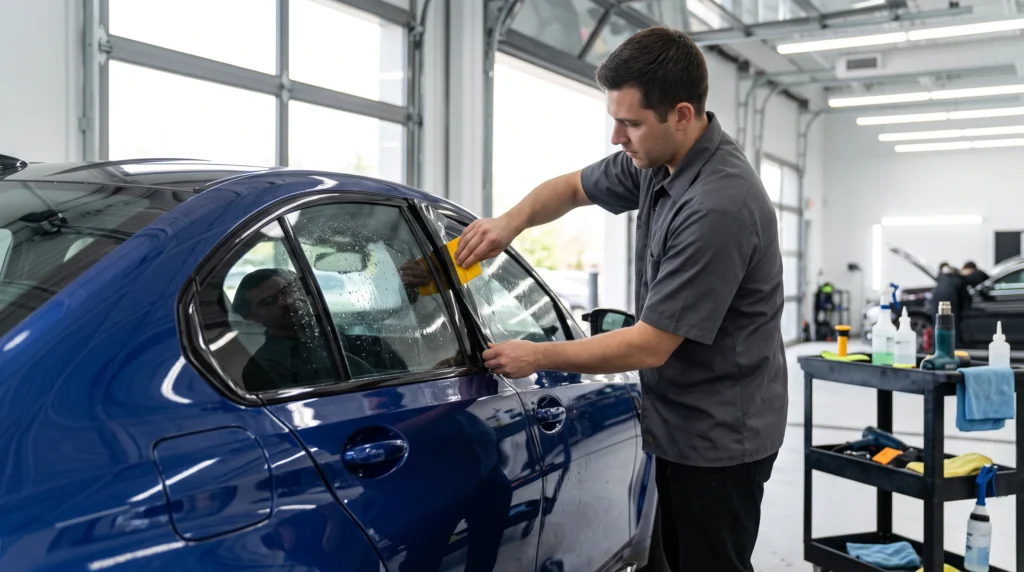
Factory automotive glass already affects light transmission before aftermarket film is installed. Once film is applied, the finished window can meter differently from the film’s nominal rating by itself.
Illinois Tint Laws at a Glance
The current Illinois Vehicle Code provides two common aftermarket arrangements when tint is placed on the windows immediately beside the driver.
50% Front / 30% Rear Setup
Illinois allows at least:
- 50% light transmission on the front side windows
- 30% light transmission on treated windows behind the driver
The statute includes a 5% variance observed by law enforcement when metering the front-side windows.
35% Front / 35% Rear Setup
Illinois also allows at least:
- 35% light transmission on the front side windows
- 35% light transmission on treated windows behind the driver
This provision also includes the stated 5% law-enforcement metering variance for the front side windows.
Here is a quick comparison:
| Window Area | 50/30 Setup | 35/35 Setup |
|---|---|---|
| Front side windows | At least 50% | At least 35% |
| Rear side windows | At least 30% | At least 35% |
| Rear window | At least 30% | At least 35% |
| Full windshield | Not permitted under the ordinary rule | Not permitted under the ordinary rule |
The complete setup matters.
A driver should not choose a front-side shade without considering what is installed behind the driver’s seat.
Illinois Windshield Tint Rules
Illinois treats the windshield separately.
Under 625 ILCS 5/12-503, tinted film generally cannot cover the full front windshield under the ordinary rule.
The law permits nonreflective tint along the upper portion of the windshield.
That strip cannot extend more than six inches downward from the top.
This means putting 35%, 50%, or another tint level across the whole windshield is not the same as using the permitted upper strip.
Illinois has separate medical provisions for qualifying drivers or passengers. Anyone relying on a medical exception should follow the state process rather than assuming a doctor’s note alone changes the ordinary rule.
Illinois Front Side Window Tint Rules
The front side windows are the windows immediately beside the driver.
These windows have the most direct statutory VLT requirements.
For Window Tinting in Schaumburg, IL, drivers commonly compare 35% and 50%.
When 50% Front Tint Fits
The statute allows at least 50% light transmission on the front side windows when the treated windows behind the driver’s seat do not fall below 30%.
This is the common 50/30 arrangement.
When 35% Front Tint Fits
Illinois also allows at least 35% on the front side windows when the treated rear windows stay at or above 35%.
This creates the 35/35 arrangement.
A 20% or 15% target on the front side windows does not fit these ordinary provisions.
Illinois Rear Window Tint Rules
Rear tint needs to be considered together with the front side windows.
If you choose 50% on the front side windows under the 50/30 provision, the treated rear windows cannot fall below 30%.
If you choose 35% on the front side windows under the 35/35 provision, the treated rear windows cannot fall below 35%.
Illinois also says a vehicle with rear treatment covered by this section must have a side mirror on each side that meets state mirror requirements.
Most newer passenger vehicles already have mirrors on both sides, but it remains part of the statute.
What About Factory Privacy Glass?
Many SUVs, crossovers, vans, and trucks have darker rear glass installed by the vehicle manufacturer.
Illinois has a separate provision for this situation.
When nonreflective smoked or tinted glass was originally installed by the manufacturer behind the driver’s seat, the statute allows at least 50% light transmission on the windows immediately beside the driver, subject to the stated metering variance.
Factory privacy glass and aftermarket window film are not the same thing.
If your SUV already has dark rear glass, tell the installer before choosing front-side film.
This is one reason Window Tinting in Schaumburg, IL should start with an inspection of the actual vehicle.
What Does the 5% Metering Variance Mean?
Illinois includes a 5% variance for law-enforcement officers metering the permitted front side windows.
The written front-side thresholds remain at least 50% or at least 35%, depending on the rear-window setup.
The variance should not be treated as a reason to deliberately choose a film below the stated statutory target.
A driver planning a legal installation should work from the listed transmission requirement rather than designing the setup around enforcement tolerance.
The glass-and-film combination can also affect the meter reading, which is another reason to discuss finished VLT with the installer.
How Window Tint Reduces Heat
Window tint can reduce the amount of solar energy passing through vehicle glass.
There are several measurements behind heat performance.
The three numbers drivers often see are:
- VLT
- TSER
- Infrared rejection
These numbers describe different properties.
VLT tells you how much visible light passes through.
TSER tells you how much total solar energy the filmed glass rejects.
Infrared rejection measures a part of the infrared energy associated with the heat you feel from sunlight.
That is why Window Tinting in Schaumburg, IL should not be chosen solely from how dark a sample looks.
What Is Total Solar Energy Rejection?
TSER stands for Total Solar Energy Rejection.
3M defines TSER as the percentage of total solar energy rejected by filmed glass.
A higher TSER figure means more solar energy is rejected under the stated test conditions.
This measurement can be more useful than darkness when heat reduction is your main goal.
A driver might choose fairly light tint for visibility while still selecting a film with strong solar performance.
That can be useful for people who want less heat without making the cabin extremely dark.
What Is Infrared Rejection?
Infrared rejection is another number used in automotive window-film specifications.
3M defines IRR as infrared rejection measured across a stated wavelength range.
3M also uses IRER, or Infrared Energy Rejection, which covers a wider infrared range and accounts for energy that can be absorbed and reradiated into the vehicle.
These figures are not interchangeable with VLT.
A film can have high infrared performance without being the darkest film available.
When comparing products, use the same measurement across films rather than mixing IRR from one film with IRER from another.
Does Darker Tint Reject More Heat?
Not necessarily.
Dark tint reduces visible light.
Heat rejection depends on film construction and the way the material handles solar energy.
This is one of the biggest misconceptions around Window Tinting in Schaumburg, IL.
A darker dyed film may block more visible light but does not automatically outperform a lighter ceramic or multilayer film for solar heat rejection.
3M’s Crystalline line is a good illustration. The manufacturer markets Crystalline around high solar and infrared rejection while offering lighter VLT choices.
That means you can compare heat performance and tint darkness as two separate decisions.
3M Ceramic IR Window Film
3M Ceramic IR Series uses nano-ceramic film technology.
3M currently says Ceramic IR can reject up to:
- 66% of total solar energy
- 95% infrared energy under its stated IR measurement
The manufacturer also describes Ceramic IR as metal-free.
3M says the metal-free construction will not interfere with GPS, satellite radio, mobile devices, or 5G signals.
Ceramic IR comes in several tint levels.
This allows a driver to think about legal VLT and heat rejection at the same time.
If you are looking for ceramic window tint, ask which products and shades are currently available before booking.
3M Crystalline Window Film
3M Crystalline uses a multilayer optical film construction.
The manufacturer says the film contains more than 200 layers while remaining thinner than a Post-it Note.
3M currently lists performance up to:
- 64% total solar energy rejection
- 99% infrared rejection
- 99.9% UV blocking across parts of the Crystalline range under stated test conditions
Crystalline is also non-metalized.
One reason drivers consider this type of film is that high heat rejection does not require choosing the darkest available glass.
For Schaumburg commuters who want more light through the windows while still addressing solar heat, that can be worth comparing.
35% vs 50% Tint for Schaumburg Drivers
The right front-side percentage depends partly on the rear setup.
35% Front Tint
Thirty-five percent gives a darker look than 50%.
It can provide:
- More daytime privacy
- More visible-glare reduction
- A darker exterior appearance
Under the Illinois 35/35 provision, the treated windows behind the driver must also stay at or above 35%.
50% Front Tint
Fifty percent lets more visible light pass through.
It may appeal to drivers who want:
- Lighter front side glass
- Easier nighttime visibility
- Less change to the original appearance
- Darker rear treatment within the 50/30 arrangement
Under the 50/30 provision, treated rear windows can go down to 30%.
If your vehicle has manufacturer-installed dark rear glass, a separate 50% front-side provision may apply.
Night Driving and Tint Darkness
Tint can feel very different at night than it does on a sunny afternoon.
A darker front side window means less available visible light reaches your eyes.
Think about situations such as:
- Turning at an unlit intersection
- Looking for a cyclist
- Watching for pedestrians
- Checking a side mirror
- Backing into a parking spot
- Driving through a dark garage
- Driving during rain
- Driving during snow
A 35% window passes more visible light than a 20% window.
A 50% window passes more than 35%.
If you drive often after dark, look through film samples from inside the vehicle rather than judging tint only from outside.
Why Existing Glass Affects Finished VLT
Factory glass is not always transmitting 100% of visible light before tint is added.
That means the final window reading can differ from the film’s nominal label.
This matters when a legal threshold is involved.
Suppose a driver picks a film because the sample says 35%.
The final glass-and-film system can meter differently depending on the original window.
This is why an installer should consider the existing glass before recommending a film for a legal target.
Factory privacy glass deserves the same attention.
What looks like aftermarket tint on the rear of an SUV may actually be dark glass produced that way by the vehicle manufacturer.
Why Professional Installation Matters
Film quality is only one part of the finished job.
Automotive glass can have:
- Curves
- Tight seals
- Defroster lines
- Borders
- Sensors
- Trim
- Small quarter windows
- Large rear glass
The film has to be fitted around these areas.
The Detail Dynasty installs window tint inside its dedicated garage in Skokie, IL & Chicago’s North Shore.
Its current service page says the indoor setting gives technicians a cleaner space for installation and allows closer attention to each window.
Dust or debris caught between film and glass can remain visible, which makes surface preparation and installation conditions worth considering.
Choosing Window Tinting in Schaumburg, IL
Start with Illinois law.
Then decide what you want the film to do.
Ask yourself:
- Do I want 35% or 50% on the front side windows?
- What is already installed behind the driver?
- Does my vehicle have factory privacy glass?
- Is heat rejection more important than darkness?
- Do I want more privacy?
- How much nighttime driving do I do?
- Is glare a problem during my commute?
- Do I want ceramic film?
- Do I care about infrared rejection?
- Do I want a lighter film with stronger solar performance?
Next, compare the technical data for the exact film.
Do not assume all ceramic films or all 35% films perform the same way.
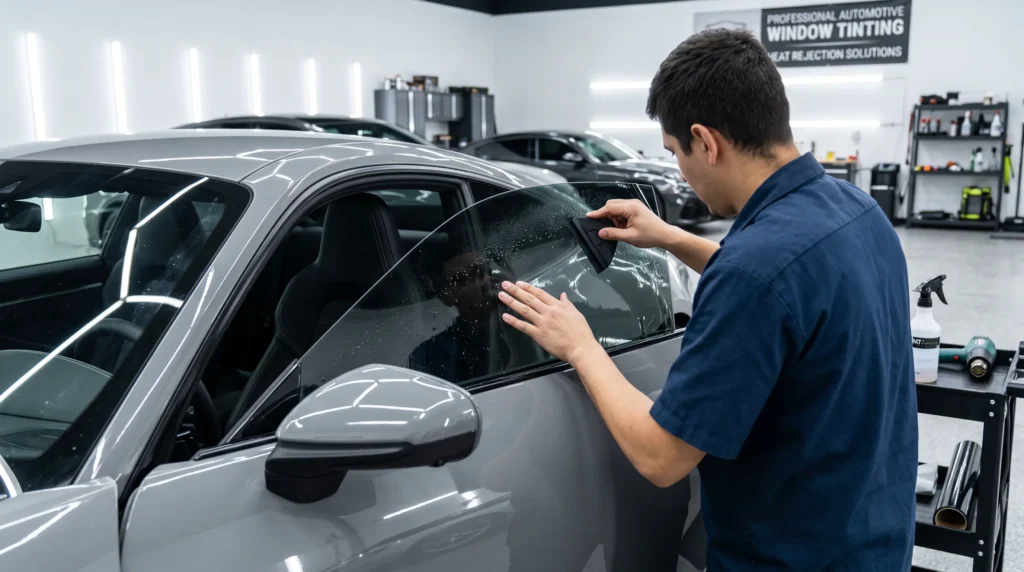
Two films with a similar VLT can have different TSER, infrared, UV, glare, and construction figures.
If you own a Tesla, you can also review The Detail Dynasty’s Tesla window tint service.
Schedule Window Tinting Near Schaumburg
Window Tinting in Schaumburg, IL can reduce visible glare, add privacy, change the look of the vehicle, and reduce solar heat through filmed glass.
The legal setup comes first.
Illinois currently provides common configurations of:
- 50% front side / 30% rear
- 35% front side / 35% rear
- 50% front side with qualifying manufacturer-tinted rear glass
The ordinary windshield rule generally limits tint to a nonreflective strip no more than six inches from the top.
After choosing a legal arrangement, compare film performance.
3M’s current data shows why darkness alone is not enough. Ceramic IR can reject up to 66% of total solar energy and up to 95% infrared energy under the company’s stated measurements. Crystalline can reject up to 64% of total solar energy and up to 99% infrared under its stated testing.
The Detail Dynasty provides window tint installation from its dedicated garage at 5050 Dempster St, Skokie, IL 60077, serving Schaumburg-area drivers through Skokie, IL & Chicago’s North Shore and surrounding Chicagoland communities.
Call (773) 216-3104 or visit The Detail Dynasty contact page to discuss legal VLT, film choices, heat rejection, and scheduling.
Frequently Asked Questions
1. What are the legal Window Tinting limits in Schaumburg, IL?
Schaumburg follows Illinois state law. The current statute allows a 50% front-side and 30% rear arrangement, or a 35% front-side and 35% rear arrangement. A separate provision permits at least 50% on the front sides when qualifying smoked or tinted rear glass was installed by the vehicle manufacturer.
2. Is 35% window tint legal in Illinois?
Yes, 35% can be used on the windows immediately beside the driver when the treated windows behind the driver’s seat also allow at least 35% light transmission. Illinois includes a 5% law-enforcement metering variance in this provision.
3. Can I use 20% tint on my front windows in Schaumburg?
Twenty-percent front-side tint does not fit the ordinary front-side configurations in 625 ILCS 5/12-503. The statute lists at least 35% or at least 50% front-side transmission depending on the rear-window setup.
4. Does darker window tint reject more heat?
Not automatically. Darkness is measured by visible light transmission. Solar heat performance uses measurements such as TSER and infrared rejection. A lighter ceramic or multilayer film may reject more solar energy than a darker film with different construction.
5. How much heat can 3M Ceramic IR reject?
3M currently states that Ceramic IR Series can reject up to 66% of total solar energy and provide up to 95% infrared rejection under its stated testing. Performance differs by film shade and glass configuration.
6. Can I tint the full front windshield in Illinois?
Under the ordinary Illinois rule, tinted film generally cannot cover the full windshield. A nonreflective strip may be installed along the uppermost portion as long as it does not extend more than six inches downward from the top. Separate medical provisions exist for qualifying cases.
7. Where can I schedule Window Tinting near Schaumburg, IL?
The Detail Dynasty lists Schaumburg, IL among its window-tint service areas and installs film at 5050 Dempster St, Skokie, IL 60077, serving customers through Skokie, IL & Chicago’s North Shore. Call (773) 216-3104 or use the contact page to discuss your vehicle and film choices.
Sources
- 625 ILCS 5/12-503: Windshields Must Be Unobstructed and Equipped With Wipers
Publisher: Illinois General Assembly
Publication Date: Current statutory text accessed August 2026
Used for: Windshield limits, 50/30 and 35/35 configurations, manufacturer-tinted rear glass, front-side metering variance, mirror rules, and medical provisions. - 3M Automotive Window Film Ceramic IR Series
Publisher: 3M
Publication Date: No publication date listed on current product page
Used for: Total solar energy rejection, infrared rejection, nano-ceramic construction, and metal-free design. - 3M Automotive Window Film Crystalline Series
Publisher: 3M
Publication Date: No publication date listed on current product page
Used for: Total solar energy rejection, infrared rejection, multilayer optical film construction, non-metalized design, and available tint levels. - 3M Auto Films Support
Publisher: 3M
Publication Date: No publication date listed
Used for: Definitions of VLT, TSER, UV rejection, IRR, IRER, and glare reduction. - The Detail Dynasty Window Tint Service
Publisher: The Detail Dynasty
Publication Date: No publication date listed
Used for: Window tint service information, indoor installation setting, Schaumburg service-area listing, shop address, phone number, and related vehicle-service information. Prices shown on the source page are intentionally not reproduced here. - The Detail Dynasty Tesla Window Tint
Publisher: The Detail Dynasty
Publication Date: No publication date listed
Used for: Related Tesla window tint internal link. - The Detail Dynasty Contact Page
Publisher: The Detail Dynasty
Publication Date: No publication date listed
Used for: Appointment and contact link.
